
CONTENT & REPURPOSING
Thought Leadership: Meaning, Examples, and a B2B Content Framework
A busy content calendar can still leave a B2B audience with no clear reason to listen. Articles, expert sessions, and reports become more useful when they explain a problem from a considered point of view and give the reader a better way…
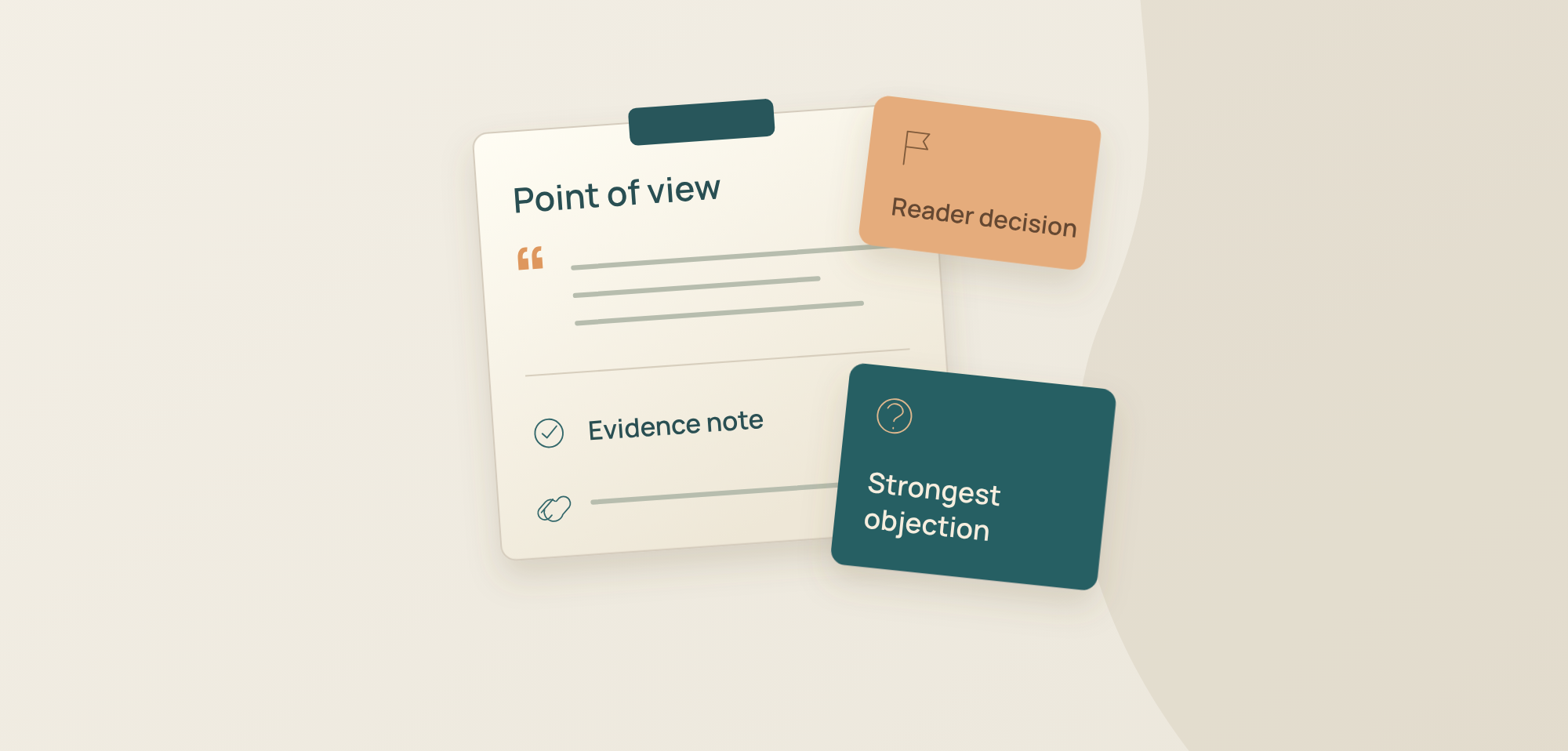
A busy content calendar can still leave a B2B audience with no clear reason to listen. Articles, expert sessions, and reports become more useful when they explain a problem from a considered point of view and give the reader a better way to make a decision.
Thought leadership is the practice of sharing a credible, distinctive point of view that helps a defined audience understand a problem or make a better decision. It combines expertise, reasoning, and supporting evidence. For a B2B content team, the work starts with the idea the audience needs to examine, then moves to the format that can explain it well.
What Is Thought Leadership?
A thought leadership contribution offers an argument the audience can evaluate. It explains what the author believes, why that view is reasonable, where it applies, and what the reader should do with it. The contribution may introduce new research, connect existing evidence in a useful way, or make an experienced practitioner’s reasoning explicit.
Distinctive does not have to mean provocative. An expert might clarify a neglected trade-off, identify a condition under which familiar advice fails, or provide a more useful method for a recurring task. The test is whether the audience gains something beyond a summary of widely available information.
Thought Leadership vs. Content Marketing
Content marketing is the broader practice of creating and distributing useful content for an audience. Thought leadership can sit within that program. Product marketing can contribute expertise too, but explaining a product’s capabilities serves a different immediate reader task. These approaches can work together without every asset needing the same label.
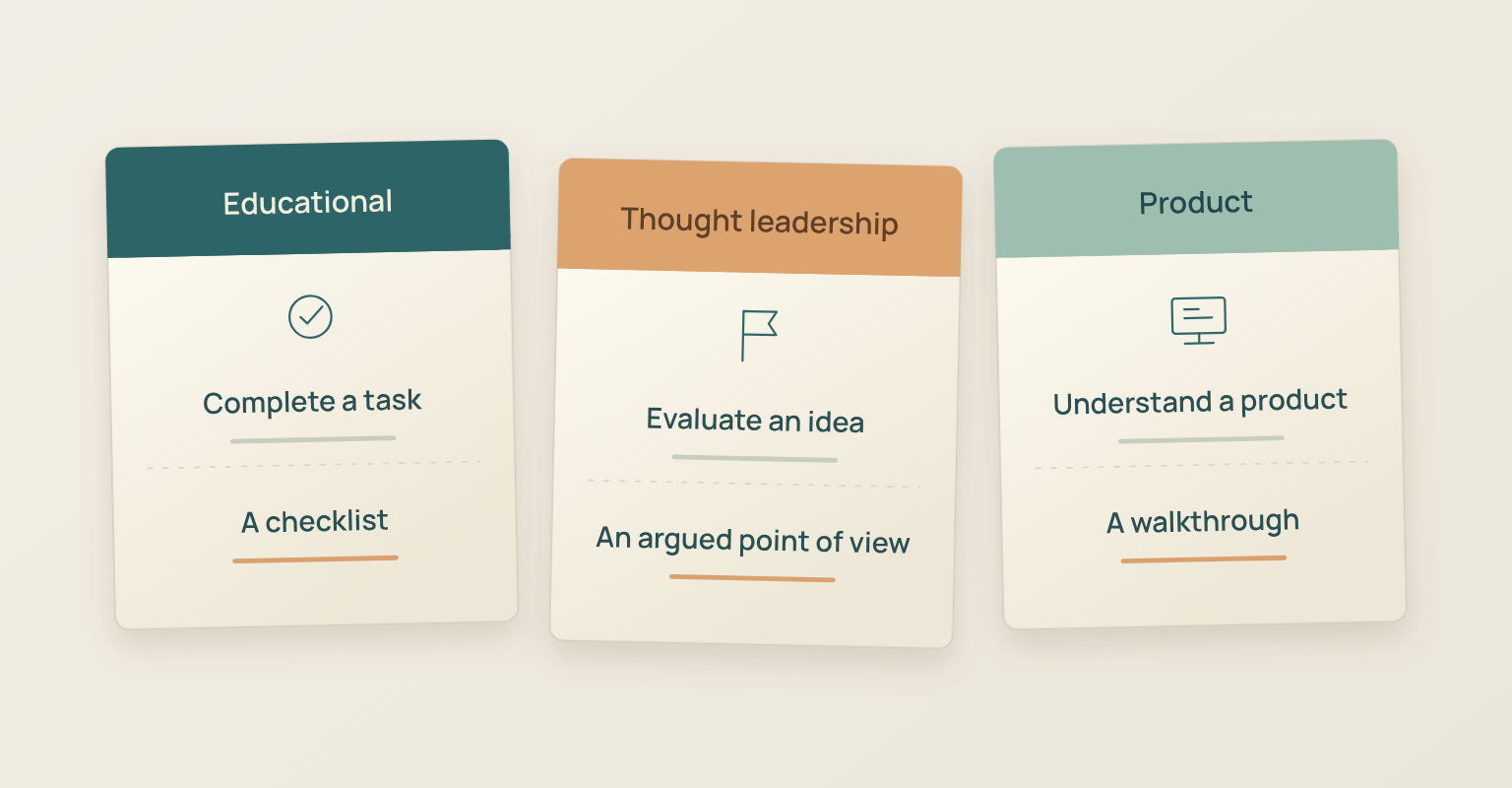
| Approach | Main Reader Task | Example |
|---|---|---|
| Educational content | Learn how to complete a task. | A checklist for preparing a live session. |
| Thought leadership | Evaluate an idea or reconsider a decision. | An evidence-backed argument about what a useful expert session should help buyers decide. |
| Product content | Understand how a specific product supports the task. | A walkthrough of an event platform’s registration and recording workflow. |
A helpful checklist does not need to claim thought leadership status. Equally, an opinion needs more than confident wording to qualify: readers should be able to inspect its reasoning and decide whether it fits their circumstances.
Why Thought Leadership Matters in B2B
B2B decisions involve people with different responsibilities. An operating team may care about execution, while another stakeholder needs to understand risk, effort, or the business case. A useful argument gives those people a shared way to examine the problem before they compare vendors.
In the 2025 Edelman and LinkedIn study, 71% of hidden decision-makers said thought leadership was more effective than conventional marketing or sales materials at demonstrating a vendor’s potential value. The survey covered 1,934 business executives in the United States. These are reported attitudes, not evidence that publishing an article causes a sale.
The CMI and MarketingProfs 2026 research found that 96% of respondents’ organizations created thought leadership, while only 4% rated their program at the leading level. Its B2B findings draw on 1,015 marketers, mostly in North America, surveyed in 2025. These self-ratings suggest that producing content and developing a mature program are different tasks.
For an event-led content program, that distinction changes the planning question. Instead of starting with a speaker slot or a recording target, decide which business assumption deserves examination and which expert can help examine it. The session then has an editorial purpose that can carry into the article or report.
Thought Leadership Examples and What to Learn from Them
Research That Makes a Less Visible Problem Easier to Discuss
The Edelman and LinkedIn report uses research on hidden decision-makers to examine people who influence a purchase without necessarily being the vendor’s main contact. As an editorial example, it shows how a defined audience problem can give a report a clear argument. The useful pattern is the connection between a specific question, disclosed research, and an interpretation readers can assess.
A Practical Question Tested Against a Published Dataset
Gong’s 2026 article about executive responses to cold email starts with an operator’s question and reports analysis of more than one million executive sales cycles. It then connects the findings to practical choices. This is a vendor-published dataset with its own context. The editorial lesson is to make the question and evidence visible, rather than to treat the findings as a universal rule.
An Illustrative B2B Event Point of View
Consider a content team deciding whether its next expert session should cover a broad industry trend or one difficult buying decision. A possible point of view is: A B2B expert session should help the audience evaluate a decision before it asks them to evaluate a vendor. This is an illustrative editorial argument, not a finding from a JakoMeet customer study.
The argument could lead to a session about choosing between two operating approaches, with an expert explaining the conditions, costs, and trade-offs. Its supporting evidence would need to come from actual audience questions, documented practice, or suitable research. A session for an audience already comparing product features might reasonably take a different approach. Naming that exception makes the idea more useful.
A B2B Thought Leadership Framework
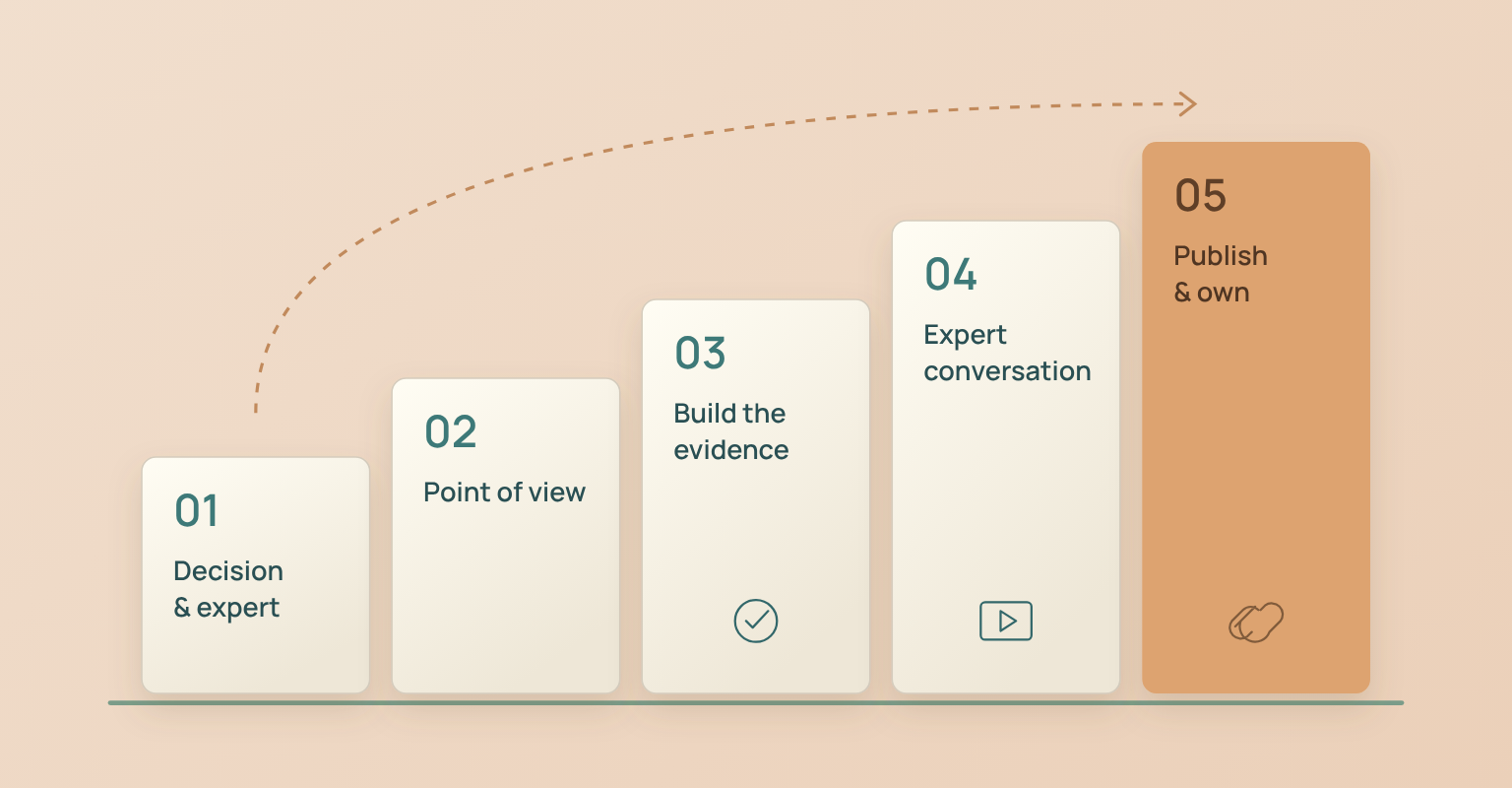
1. Choose a Decision and a Credible Expert
Start with a decision the audience has difficulty making. A broad subject such as customer education becomes more actionable when framed as deciding which problem an expert session should resolve. Specify the audience’s role, the situation that creates the question, and the action the content should help them evaluate.
If those inputs are unclear, use B2B audience research to establish the audience and its questions before drafting. Then choose an expert with relevant experience or research. Seniority is less useful than the ability to explain what happened, what they observed, and where their judgment might change.
2. Write a Point of View That Can Be Challenged
Write the central argument in one sentence. A practical pattern is: for this audience, in this situation, this approach is worth considering because of this reason. The sentence should contain an actual judgment. A topic label such as ‘the future of events’ leaves the reader guessing what the author believes.
Ask a colleague to state the strongest reasonable objection. If the argument cannot accommodate that objection, narrow it or gather better evidence. For the illustrative event argument, an obvious objection is that buyers sometimes need a direct product walkthrough. The response should clarify the intended audience and stage of the decision, not dismiss product education.
3. Build and Test the Evidence
Separate the argument into claims that need support. A numerical claim needs a traceable dataset and denominator. A claim about recurring behavior needs documented observations. A recommendation based on experience should explain the circumstances behind that judgment. These forms of evidence can complement one another, but they should not be presented as interchangeable.
Keep an evidence note for each important claim: the source, publication or collection date, relevant population, and limitation. Check whether the source actually supports the sentence you have written. A survey of marketers’ opinions, for example, cannot establish the commercial effect of an event format.
Look for evidence that could weaken the argument as well as evidence that supports it. If the idea only works for a particular audience, budget, or operating model, say so. An honest boundary helps readers apply the advice and gives the expert a clear basis for answering questions.
4. Develop the Idea Through an Expert Conversation
An interview, roundtable, or live session can expose reasoning that does not appear in a polished first draft. Prepare prompts around the decision: What do teams usually assume? What observation changed your view? When would you recommend another approach? What should the audience examine before acting?
Use the discussion to test the argument, rather than simply collect agreeable quotations. Ask the expert to distinguish observed facts from interpretation and to explain an exception. Audience questions can reveal where the explanation is unclear, although a small group’s reactions should not be reported as a representative market finding.
Choose a live format when discussion or challenge improves the idea. Choose a written format when the reader needs to compare evidence at their own pace. An expert does not need to appear in every channel, and a useful point of view does not depend on hosting an event.
5. Publish a Useful Argument and Assign an Owner
Give the reader a clear sequence: the decision, the argument, the evidence, the boundary, and the practical implication. Identify the expert and link to the research behind material claims. When a customer example is used, obtain permission and distinguish the customer’s results from the author’s broader recommendation.
Assign an editor to maintain the source notes and an expert to approve the interpretation. Once the core argument is sound, use the webinar content repurposing workflow for turning a recorded discussion into supporting assets. Keep each asset faithful to the original claim and its limits; distribution should not strengthen the claim beyond the evidence.
A Copyable Thought Leadership Brief
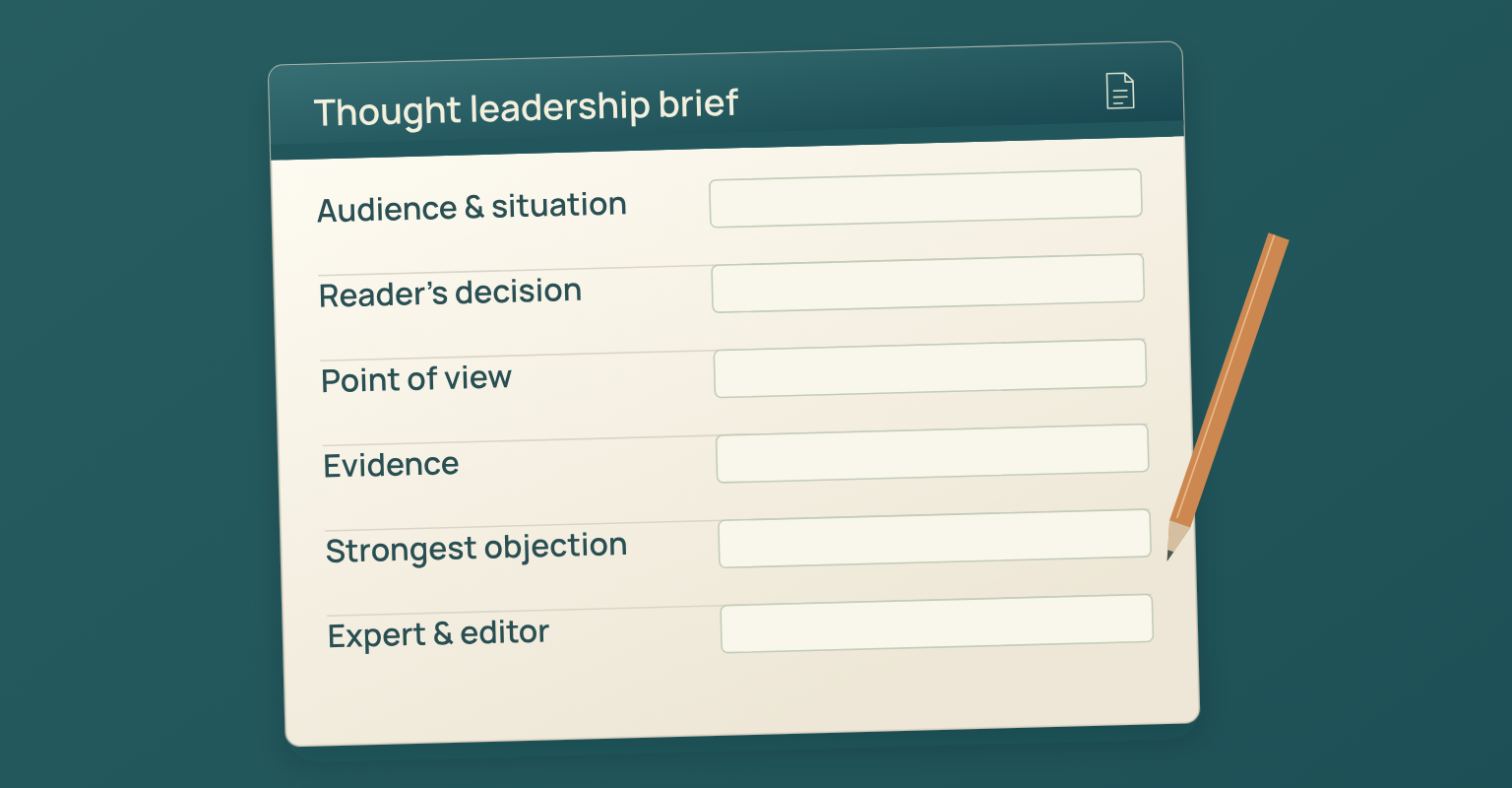
Use this brief before commissioning an article or expert session. Each field should help the expert and editor decide whether the idea is ready to develop. If the evidence or objection field is empty, return to research before expanding the publishing plan.
- Audience and Situation: Who faces the decision, and what has made it relevant now?
- Reader’s Decision: What should the reader be better able to evaluate after consuming the content?
- Current Assumption: Which common belief, overlooked trade-off, or incomplete explanation will you examine?
- Point of View: What specific argument will the expert make?
- Evidence: Which documented observations, examples, or research support each material claim?
- Strongest Objection and Boundary: When might the argument fail, and what would change the recommendation?
- Practical Implication: What can the reader inspect, discuss, or do next?
- Expert and Editorial Owner: Who can defend the argument, verify its wording, and maintain its sources?
Worked Example for an Expert Session
For a B2B product education team, the audience might be operators considering a new workflow but still unclear about the operational trade-offs. Their decision is what to evaluate before selecting a tool. The current assumption is that a broad trend discussion will provide enough value for this audience.
The proposed point of view is the event argument above: help the audience evaluate the decision before asking it to evaluate a vendor. Evidence to gather includes real questions from this audience and an expert’s documented examples of the trade-offs involved. These are research inputs to collect, not results already established.
The strongest objection is that some attendees are ready for product detail. The boundary is therefore an audience still defining its approach. The practical output is a short list of conditions to compare, with a product walkthrough available as a separate next step. An experienced operator owns the argument and an editor verifies its supporting material.
Measure Whether the Idea Is Useful
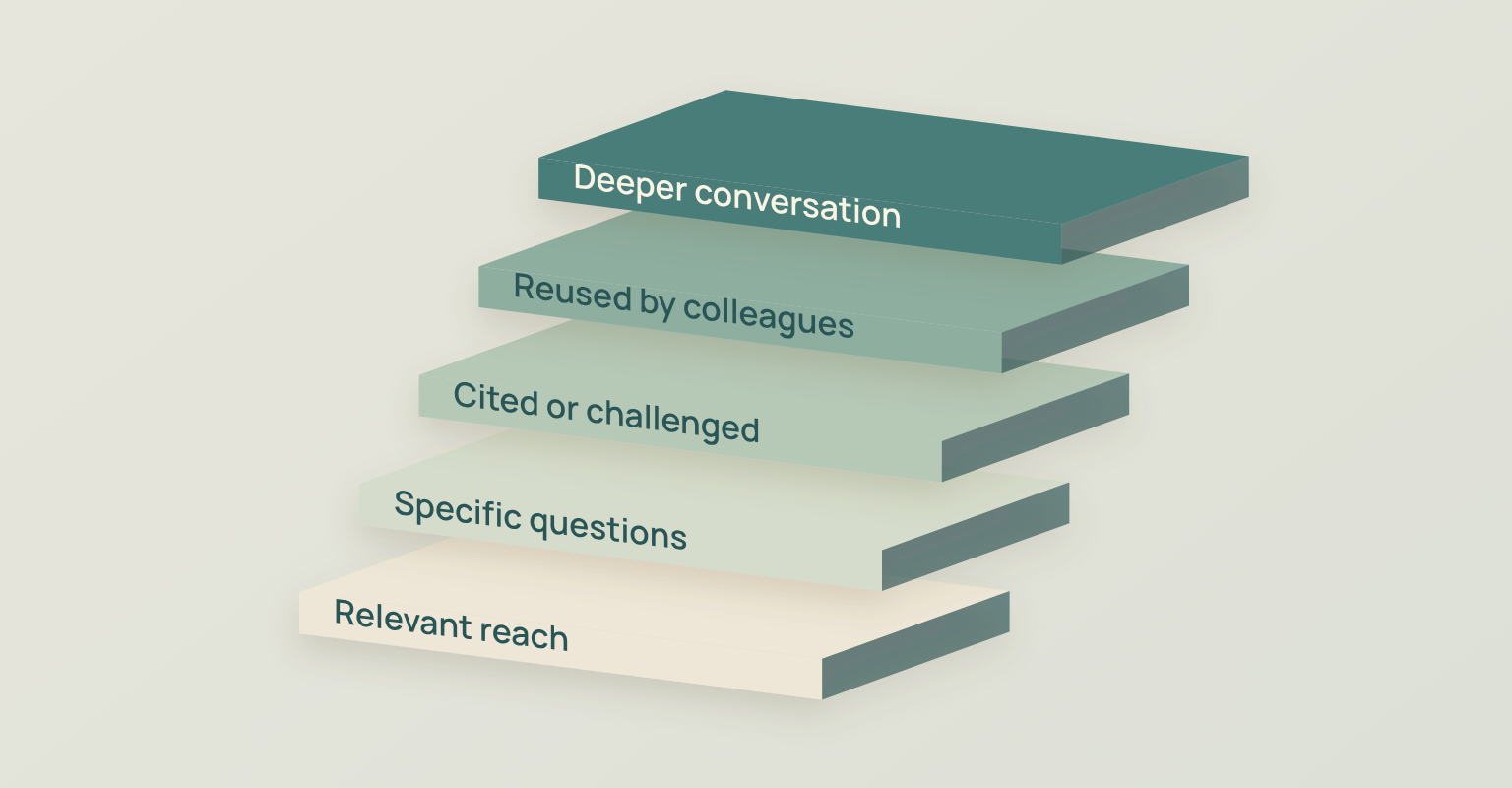
Decide what useful response would look like before publishing. For an early argument, that may be a reader describing a previously unclear trade-off, asking a more specific follow-up question, or using the framework in an internal discussion. Record the substance of feedback so the team can distinguish interest in the idea from polite engagement.
Review reach alongside these responses, with the audience and distribution context attached. Track whether the argument is cited, challenged, reused by relevant colleagues, or developed into a deeper expert conversation. These signals help you decide what to clarify or investigate next. They do not, by themselves, prove revenue impact or justify attributing an entire buying decision to one piece of content.
Where JakoMeet Fits in the Program
When an expert discussion is the right format, JakoMeet can support the event workflow around registration, live delivery, and the recording. The content team still owns the point of view, evidence, expert preparation, and editorial approval. See the JakoMeet event workflow to understand how that delivery layer fits your program.
Use the session to make a valuable argument understandable and open to questions. The recording can preserve the conversation, while an edited article gives readers a source-linked explanation they can revisit. Each format should serve the same audience decision.
Frequently asked questions
Who Can Create Thought Leadership?
A credible practitioner can create thought leadership without being a senior executive. The person should understand the problem, explain the reasoning behind a recommendation, and acknowledge its limits. A founder, customer success lead, engineer, researcher, or event operator may each contribute expertise within their own area.
Does Thought Leadership Require Original Research?
No. Original research is one route; a useful synthesis, a clearly explained method, or a specific lesson from practice can also support an original point of view. Cite borrowed evidence and identify experience-based judgments as judgments. New data becomes necessary when the claim itself depends on proving a new pattern.
Can a Company Be a Thought Leader?
A company can build a reputation for useful ideas through a consistent program with accountable experts. Make the people and reasoning behind each contribution visible. A corporate logo or a regular publishing schedule alone does not establish expertise.
Is a Webinar Automatically Thought Leadership?
No. A webinar is a delivery format. It becomes a vehicle for thought leadership when the discussion develops a defensible point of view and helps the audience evaluate a decision. A product walkthrough or a broad panel can be valuable without serving that purpose.
Can AI Help Create Thought Leadership Content?
AI can help organize source material, compare draft structures, or suggest questions for an expert. The named expert and editor still need to verify evidence, challenge the argument, and approve the final interpretation. Do not publish an invented experience, quotation, or dataset as the basis of a claim.
How Often Should a Thought Leadership Program Publish?
Publish when an idea has enough relevance, evidence, and editorial attention to be useful. Set a sustainable review cadence around expert availability and the audience’s decisions. A monthly calendar is an operating choice, not proof that every month will produce a defensible new argument.