
AUDIENCE & PROMOTION
B2B Audience Research: How to Find Where Buyers Pay Attention
Find where B2B buyers pay attention by combining account and buying-role research with evidence about their problems, language, and information sources, then testing your assumptions before scaling.
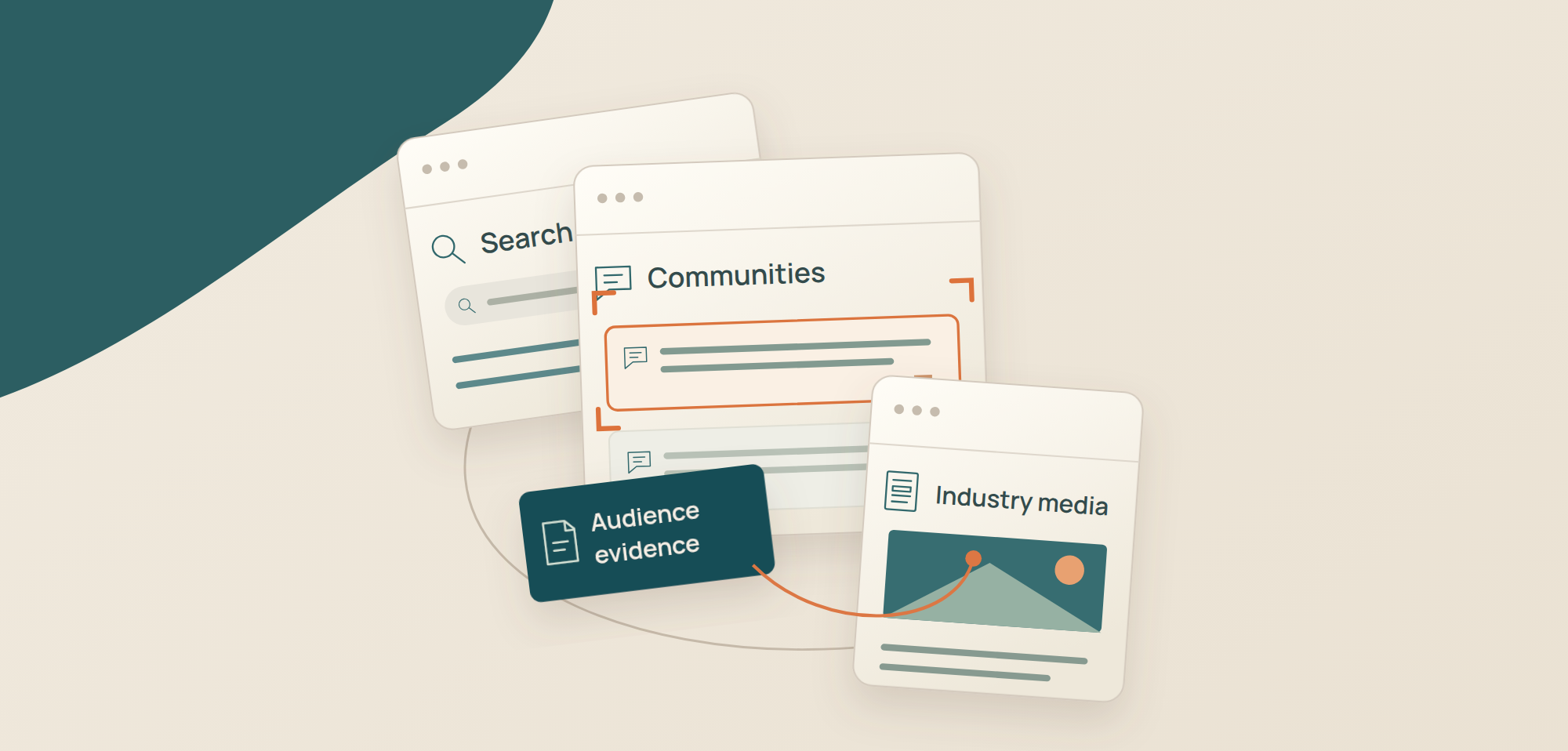
The useful output of B2B audience research is a working evidence model: it tells the team what to say, where to show up, who needs to see the message and what to test next. For an event team this work comes before the promotion calendar, because it shapes the topic, the speaker, the registration promise, the partner list, the channel mix and the follow-up assumptions. For a wider marketing team, the same research guides content, campaigns, product marketing and sales enablement.
The discipline that makes it reliable is separating what the team knows from what it assumes. An ICP, a CRM segment, a sales opinion, a social audience, a survey result and an interview quote are all useful, and they answer different questions. Combine them deliberately and keep their limits visible.
B2B Audience Research at a Glance
| Stage | Primary Question | Evidence | Output |
|---|---|---|---|
| 1. Define the decision | What must this research help us decide? | Campaign objective, business question, current uncertainty | Research brief |
| 2. Set the market boundary | Which accounts are in and out? | Industry, geography, size, use case, maturity, exclusions | Account boundary |
| 3. Map relevant roles | Who experiences, evaluates, approves, blocks, or uses the outcome? | Customer interviews, CRM roles, sales and success context | Buying role map |
| 4. Gather first party evidence | What have real customers and prospects already shown us? | CRM, campaign sources, questions, support themes, prior events | Evidence inventory |
| 5. Conduct primary research | What do people say in their own language? | Interviews, carefully designed surveys, observation where appropriate | Problem and language themes |
| 6. Map the information environment | Where do they learn, search, compare, and ask peers? | Search behavior, publications, communities, referrals, interviews | Attention map |
| 7. Test reachability | Can our team reach them credibly and measure the result? | Channel access, costs, partner routes, campaign tests | Channel scorecard |
| 8. Validate and update | Which assumptions survived real campaign behavior? | Qualified visits, registrations, source quality, questions, outcomes | Updated audience model |
Start with the Decision the Research Must Support
"Understand our audience" is not a brief. A useful brief names the decision that will change because of the research: choosing a topic, deciding whether a partner audience is relevant, finding a channel beyond the owned email list, narrowing paid targeting, changing the registration promise, or understanding why one source brings registrations but weak attendance. Write that decision down before collecting data. It keeps the team from gathering interesting facts that never change an action, and it separates research, which reduces uncertainty before a decision, from measurement, which evaluates what happened after one.
Define the Market Boundary Before You Build Personas
Decide which organisations are inside the research population and which are out. Useful boundaries include industry, geography, company size, business model, technical environment, regulatory context, product maturity, current process and the problem the organisation is trying to solve. The aim is a population explicit enough that evidence can be read consistently, not a perfect database filter.
For U.S. industry classification, the Census Bureau's NAICS taxonomy is a standard starting point. Treat it as a boundary input rather than an ICP: two companies in the same code can still have different buying processes, urgency, technology and event needs.
Use Firmographic Boundaries as Filters, Not Personas
Company attributes tell the team where to look. They do not explain why a person pays attention, which problem language they use, what evidence they trust or who else influences the decision. Treat them as the outer boundary and investigate the people, situations and behaviours inside it.
Write Exclusion Rules
Exclusions are as useful as inclusions. If the campaign is not for agencies, for companies below a certain scale, for current customers or for organisations without a required process, document it. Later, exclusion rules show whether a registration came from the intended market or just from a large reachable audience.
| Boundary Dimension | Question to Answer | Example Evidence | Common Mistake |
|---|---|---|---|
| Industry | Which operating environments actually share the problem? | NAICS category, customer list, sales win and loss patterns | Using a broad industry label as proof of common needs |
| Company characteristics | Which size, maturity, model, or infrastructure changes the problem? | CRM fields, implementation history, product usage | Choosing arbitrary employee bands because a database offers them |
| Geography | Where can the team serve, support, or legally communicate? | Service coverage, sales ownership, market rules | Treating location as a proxy for language or behavior |
| Situation | What must be true for the problem to matter now? | Trigger events, process change, launch, renewal, growth stage | Targeting static attributes while ignoring the current job |
| Exclusions | Who should not shape this research or campaign? | Disqualifiers, unsupported use cases, existing contracts | Keeping every reachable account in the target population |
Map the Buying Group, Not Only the Visible Contact
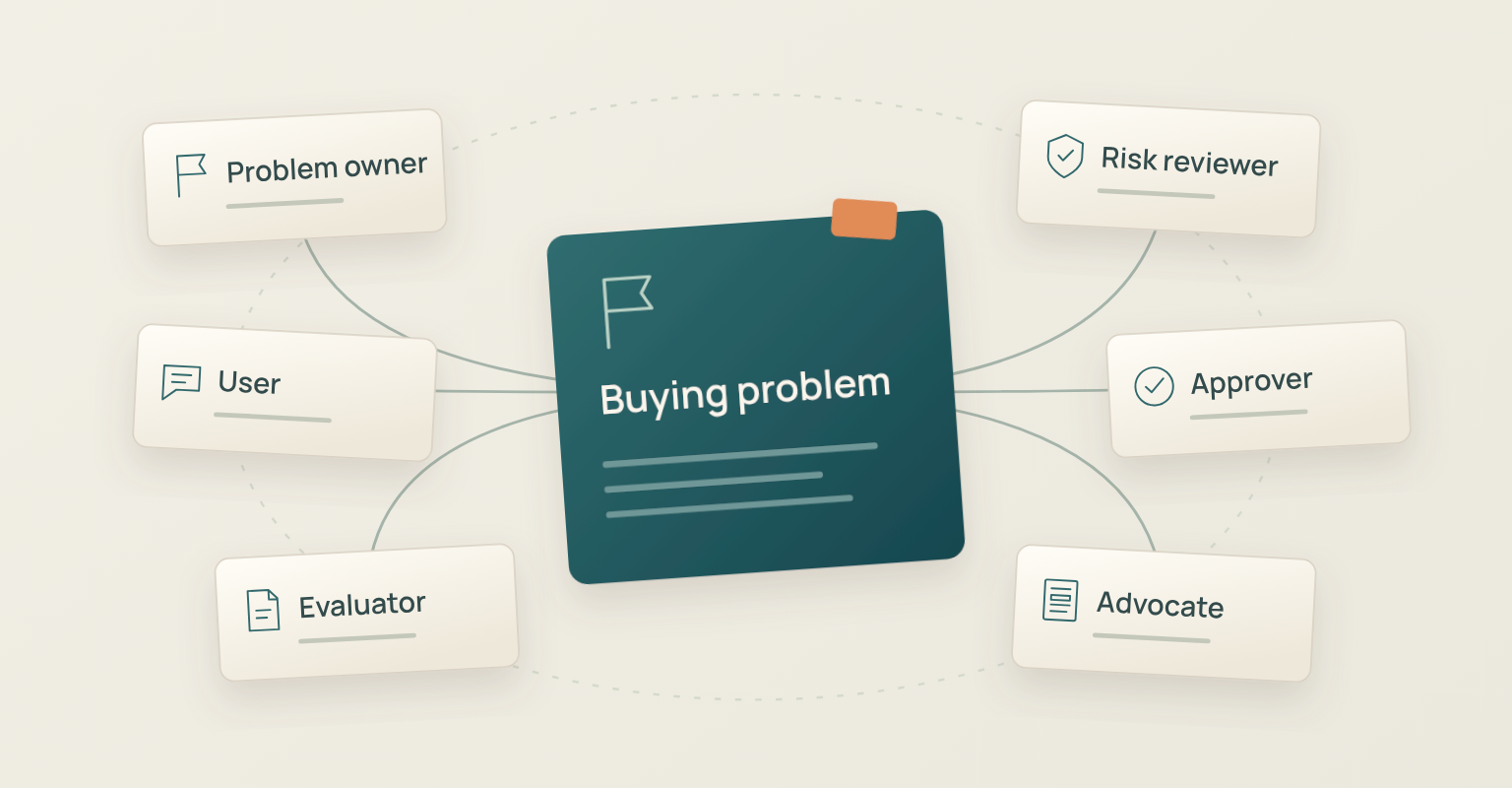
A single job title rarely captures everyone who shapes a B2B decision. Instead of asking "who is our persona", map the roles that experience the problem, use the solution, evaluate it, approve spend, review risk or influence internal adoption. In a small organisation one person may hold several of those roles; a large account may split them across teams.
Keep the map as a set of hypotheses for interviews and account evidence to test. In one segment finance may matter early; in another, technical review may follow after the business team has aligned. The research should discover the sequence, not impose it.
| Role Hypothesis | What to Learn | Useful Evidence | What Not to Assume |
|---|---|---|---|
| Problem owner | Where does the problem appear in daily work? | Interview examples, support issues, workflow evidence | The problem owner controls budget |
| User or operator | What makes the current process hard or risky? | Task examples, workarounds, product or process data | Heavy usage equals purchase authority |
| Evaluator | What must be compared or proven? | Evaluation criteria, demo questions, requirements | The evaluator is the final decision maker |
| Risk or process reviewer | What could block approval? | Security, legal, finance, procurement concerns | Invisible stakeholders do not matter because they never click marketing |
| Approver | Which outcomes justify action now? | Budget context, business case, timing, alternatives | Executive seniority guarantees topic interest |
| Internal advocate | What evidence can they carry to other stakeholders? | Questions, peer proof, internal language | A champion can create consensus alone |
Build an Audience Evidence Stack
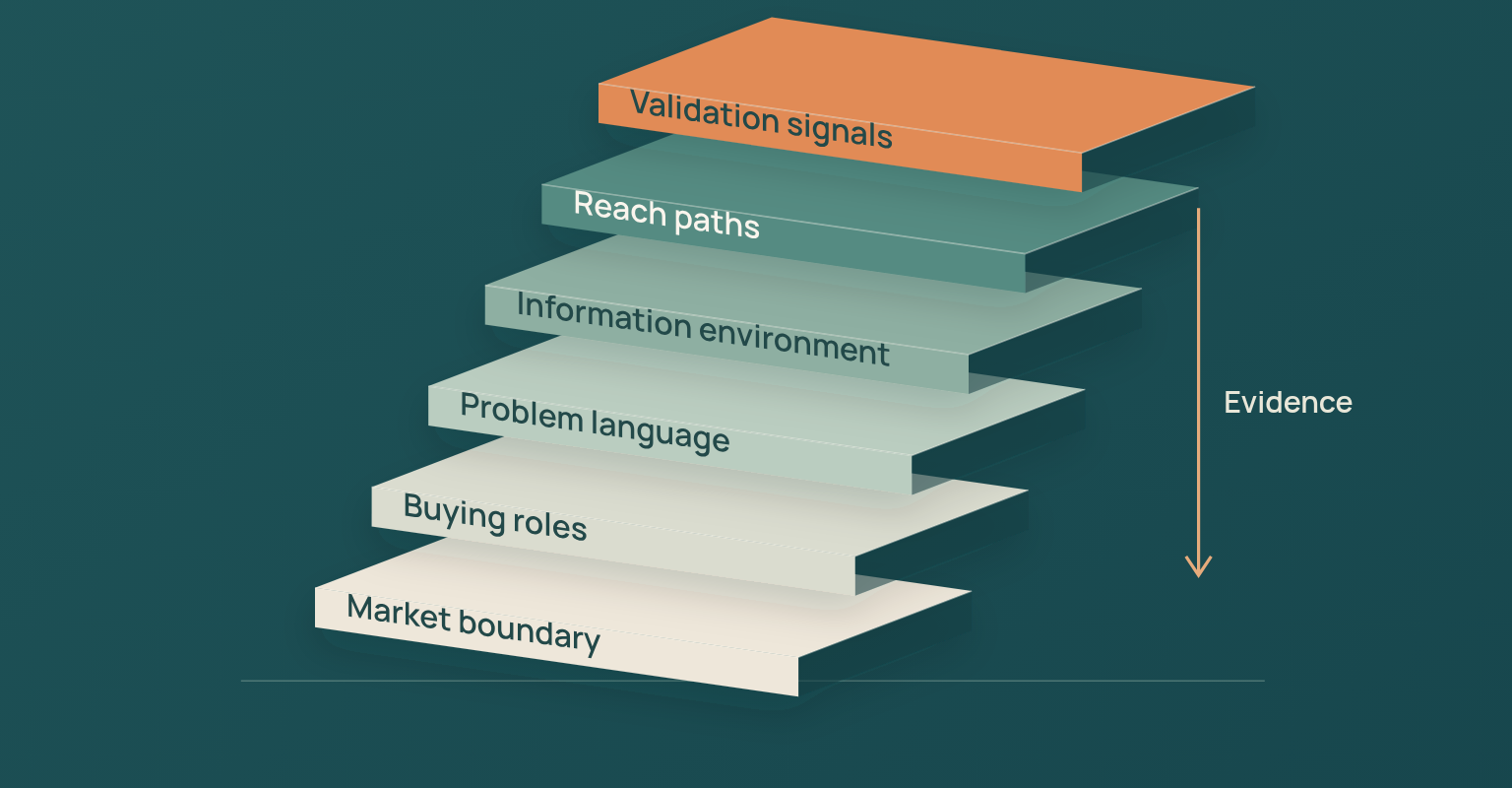
A strong audience model draws on evidence that answers different questions. JakoMeet's working model uses six layers: market boundary, buying roles, problem language, information environment, reach paths and validation signals. One layer can be strong while another stays uncertain, which makes the research gaps visible before the campaign starts.
| Layer | Question | Evidence Sources | Primary Limitation |
|---|---|---|---|
| Market Boundary | Which companies belong in the population? | Industry classification, CRM accounts, service constraints, win and loss patterns | Firmographics do not explain motivation |
| Buying Roles | Which people experience, evaluate, approve, or block? | Interviews, sales context, customer success, CRM roles | Recorded contacts may omit hidden roles |
| Problem Language | How do people describe the job, friction, and desired outcome? | Interview transcripts, questions, support themes, search terms | Internal product language can contaminate interpretation |
| Information Environment | Where do they learn, search, compare, and ask peers? | Interviews, search results, publications, communities, referrals | Visible activity is not the whole population |
| Reach Paths | Which routes can the team actually use? | Owned lists, partners, speakers, paid audiences, communities, managed targeting | Audience presence does not guarantee practical access |
| Validation Signals | Which assumptions survived campaign behavior? | Source quality, registrations, attendance, questions, follow up actions | Campaign behavior reflects the offer and execution as well as the audience |
Start with First Party Evidence You Already Have
Before commissioning new research, inventory what the organisation has already learned from real relationships: CRM notes, sales call themes, customer success conversations, support tickets, prior registration sources, event questions, poll responses, replay behaviour, content performance, win and loss notes, account history. This is a way to begin with concrete questions instead of a blank page, not a shortcut around primary research.
Keep each piece in its context. A support ticket reveals friction but does not prove demand. A webinar question reveals a concern but does not prove buying intent. A sales note holds useful language but remains the seller's record. Note who produced the evidence, which population it represents, when it was collected and what should not be inferred from it.
Create an Evidence Inventory
| Source | What It Can Reveal | Population | Important Check |
|---|---|---|---|
| CRM and sales notes | Account context, stated objections, roles, deal language | Known prospects and customers | Separate direct buyer statements from seller interpretation |
| Customer success and support | Operational problems, adoption barriers, recurring questions | Existing customers | Do not assume prospects have the same needs |
| Past event data | Sources, registration patterns, attendance, questions, polls | People exposed to prior events | Topic and promotion strategy shaped who appeared |
| Website and content data | Search terms, page paths, resource demand | Known and anonymous visitors | Traffic is not a representative audience sample |
| Partner feedback | Adjacent needs, introductions, market language | Partner accessible networks | Partners may overrepresent their own audience |
| Win and loss evidence | Decision criteria and alternatives | Evaluated opportunities | Loss reasons are often incomplete or filtered |
Conduct Interviews That Reveal Decisions, Not Compliments
Interviews work best when they reconstruct a real situation: what happened, what the participant did, what information they looked for, who became involved, what was hard to compare and what changed the next action. "Would you attend a webinar about this?" asks people to predict or approve a concept, and those answers are weaker than a detailed account of recent behaviour.
Recruit across Meaningful Differences
Recruit participants because they can illuminate the research question, not because they are easy to reach. If company size, role, industry, geography, maturity or relationship status could change the answer, include those differences deliberately and keep each segment visible in the notes, so one articulate participant does not quietly become the voice of the market.
Quantitative samples deserve the same scrutiny. Ipsos's 2024 guidance on B2B research samples reports substantial variation across panels and expert networks and recommends examining recruitment and verification practices instead of assuming every source yields equivalent respondents. Ipsos is a research vendor, so read it as directional context.
Use a Copyable Interview Guide
- Walk me through the last time this problem became important enough to act on.
- What was happening in the business at that moment?
- What did you try before looking for outside information or a new solution?
- Which words did you use when you searched or asked someone for help?
- Where did you look first, and why did you trust that source?
- Which people inside or outside the company became involved, and what did each care about?
- What made an article, event, vendor, peer or expert worth paying attention to?
- Which information looked relevant but turned out not to help?
- What evidence did you need before you were comfortable taking the next step?
- What would have made the process easier or faster?
- If you had to explain the problem to a colleague tomorrow, what would you call it?
Adapt the guide to the decision. Follow concrete examples, ask what happened next, and keep what the participant did separate from what they now think they would do.
Do Not Use a Universal Interview Quota
Qualitative sample size depends on purpose and population. A 2022 systematic review found that studies with relatively homogeneous populations and narrow objectives often reached saturation within 9 to 17 interviews, while broader or more complex studies needed more. Use that for planning, not as a stopping rule. In practice, review what each additional interview changes and continue while new roles, objections, language, sources or decision patterns keep appearing. When segments give different answers, that is a finding, not something to average into one persona.
Write Research Questions That Do Not Teach the Answer
Interviews and surveys produce precise-looking data from poorly written questions. Avoid questions that contain the preferred answer, combine two ideas, assume the participant already has the problem, or use internal product language respondents would not normally use. Pew Research Center's guidance on writing survey questions shows how wording, response options and question order shift answers and recommends clear, specific, single-idea questions tested before use. Pew works on public opinion research; the discipline transfers directly to B2B surveys.
| Weak Question | Why It Is Weak | Stronger Research Prompt |
|---|---|---|
| How valuable would an automated event platform be for your team? | Introduces the solution and asks for a favorable hypothetical judgment | Tell me about the last event workflow your team had to coordinate. What was difficult? |
| Do you struggle with promotion and follow up? | Combines two jobs and presumes struggle | How did people hear about the event? What happened after they registered? |
| Which feature matters most: AI insights, analytics, or automation? | Forces internal product categories before the problem is understood | What information did you need after the event, and what did you do with it? |
| Would you attend a webinar about lead generation? | Measures a hypothetical stated preference | Which lead generation topics have you recently spent time learning about? Where? |
| How often do you use LinkedIn for research? | Starts with a channel and may overstate its importance | When you need to learn about this problem, where do you usually begin? |
Separate Audience Research from Sales Prospecting
Research participation should not be disguised sales outreach. If someone agrees to an interview or survey for research, do not quietly convert that participation into a sales action. Make the purpose, data use, incentive, recording, recontact and any commercial follow-up clear from the start. The 2025 ICC/ESOMAR International Code requires research to be legal, honest, transparent and truthful, limits personal data collection to the research purpose, keeps research clearly distinct from non-research activities, and asks for transparent reporting of population limits and of the line between findings, interpretation and recommendations. It is a professional standard, applied alongside the law of each market.
Map the Information Environment, Not Just Social Platforms
"Which social platform is our audience on?" is too narrow. B2B buyers learn through search, vendor websites, peer conversations, professional media, communities, newsletters, events, analysts, partners, colleagues, video calls and sales conversations. The research task is to learn which sources appear at which moments and what job each performs.
In McKinsey's 2024 B2B Pulse Survey, nearly 4,000 decision makers across 13 countries reported using an average of ten interaction channels across the buying journey, with company websites, in-person sales and video-conference interactions among the most used. That is a broad international survey, not a prediction for your segment.
Ask interview participants to reconstruct the information path around a real decision: which source introduced the issue, which helped them understand it, which provided proof, which person helped compare options, and where they went to ask a detailed question. That map is more useful than a ranked list of popular channels.
Separate Audience Presence from Channel Reachability
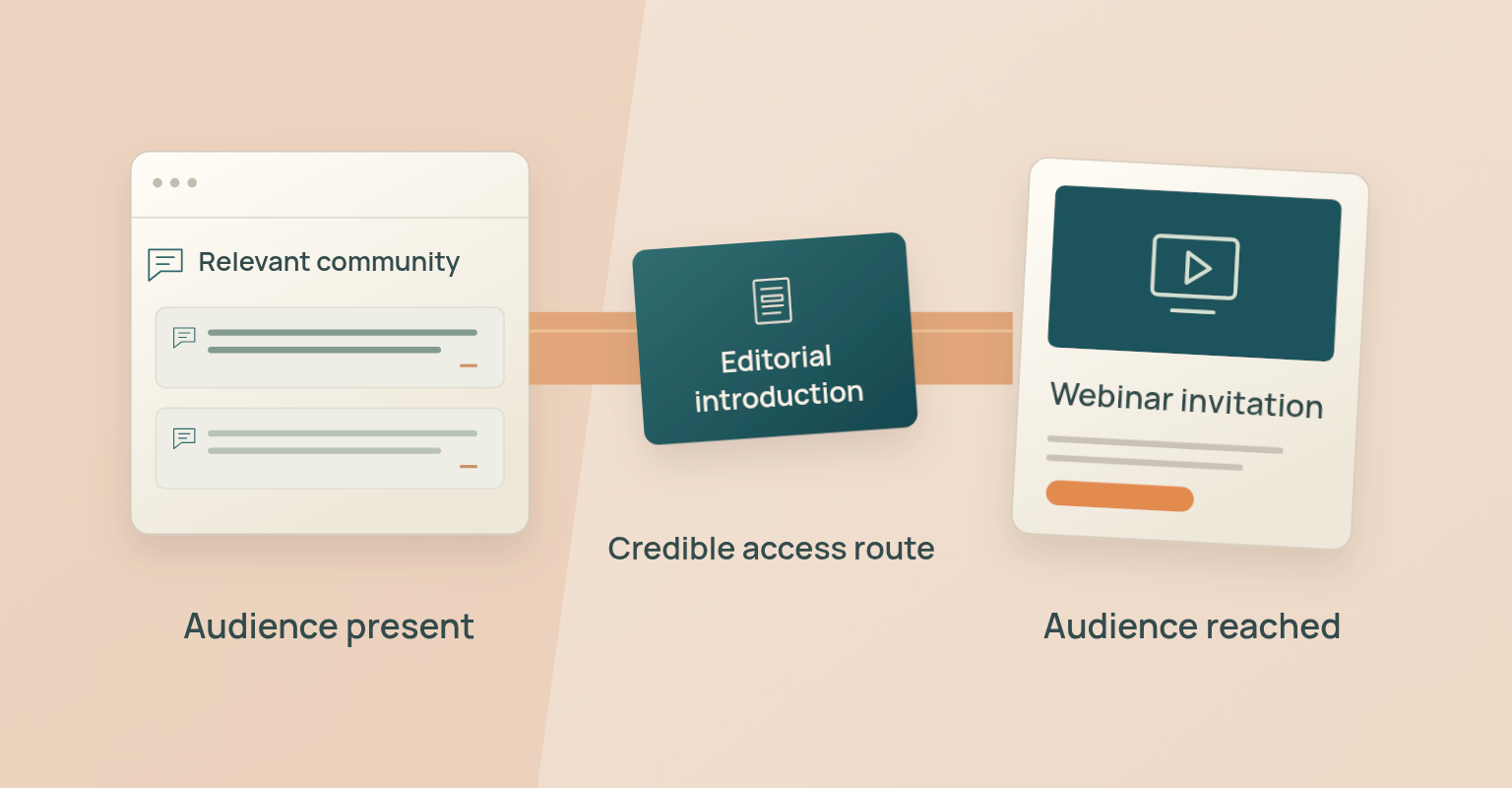
A channel can contain many relevant people and still be a poor route for a campaign. Presence answers "are they there?". Reachability asks whether the team can earn or buy credible access, deliver the right format, exclude irrelevant people, measure the result and stay within cost and permission constraints.
| Question | Presence Evidence | Reachability Evidence | Decision |
|---|---|---|---|
| Are relevant people present? | Interview mentions, visible contributors, audience data, referral patterns | Not enough on its own | Continue research |
| Can we access them? | Membership or platform availability | Owned relationship, partner route, speaker network, paid targeting, managed audience product | Identify usable path |
| Will our format fit? | Topics and conversations visible in the channel | Examples of credible educational formats and realistic distribution | Adapt asset and message |
| Can we control waste? | Broad audience size | Exclusion options, targeting criteria, partner fit, list quality | Estimate efficiency risk |
| Can we measure the path? | Platform activity | Source naming, referral data, registration source, downstream behavior | Define test and denominator |
| Can we operate responsibly? | Public availability | Permission, privacy, community rules, contract, brand risk | Approve or reject channel |
Use a Channel Reachability Scorecard
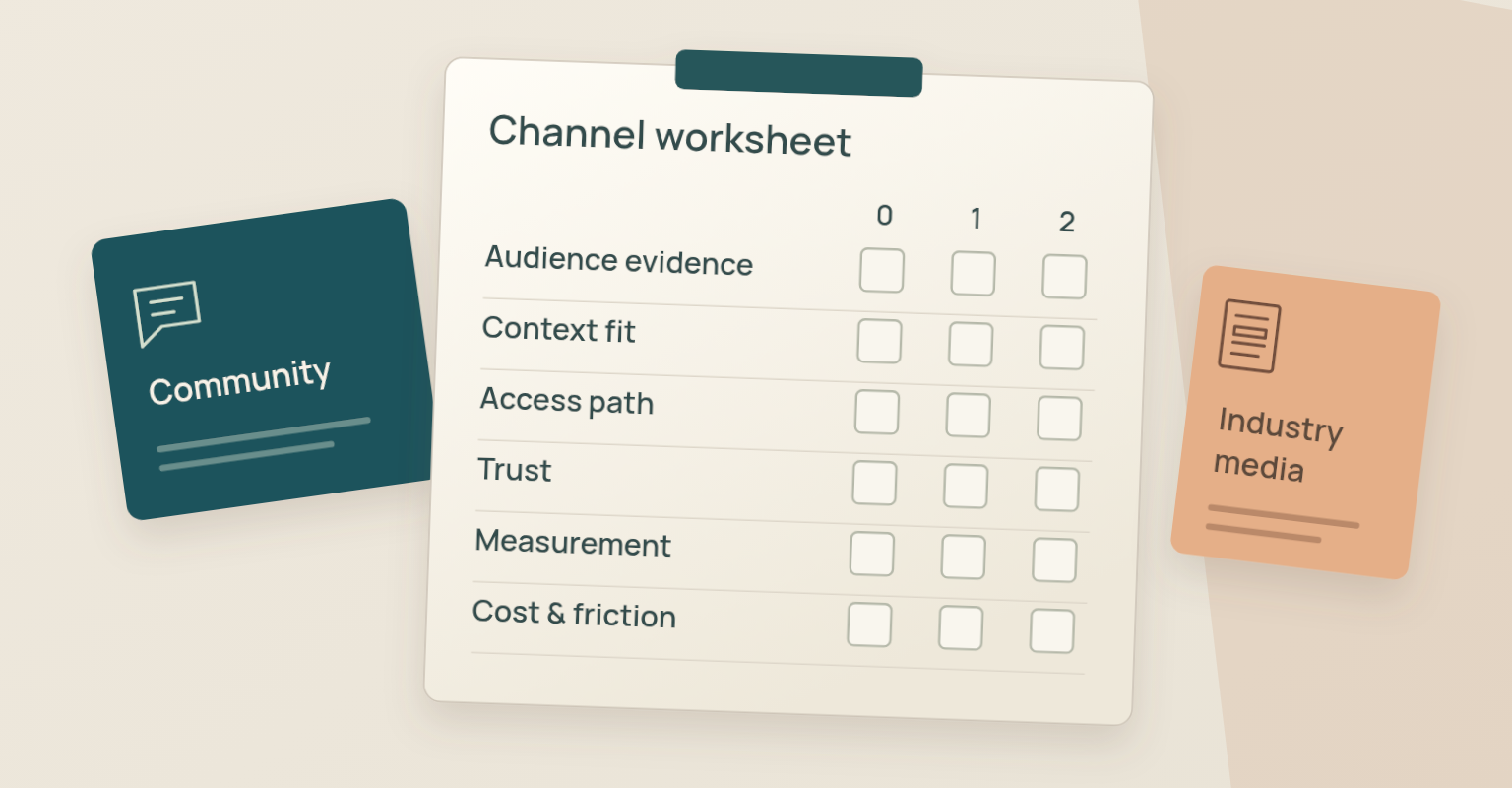
A scorecard makes the evidence behind a channel decision visible; it does not replace judgement. Score each dimension 0, 1 or 2 and require a note for every score. A channel with strong presence but no credible access path should not get the same treatment as one where the team already has a trusted partner.
| Dimension | 0 | 1 | 2 |
|---|---|---|---|
| Audience Evidence | Mostly assumption | Some indirect evidence | Repeated evidence from multiple sources |
| Context Fit | Audience is present for unrelated reasons | Some relevant conversations or formats | The problem is discussed in a context that fits the campaign |
| Access Path | No practical route | Route exists but depends on untested paid or partner access | Owned, partner, speaker, paid, or managed route is clear |
| Trust | Brand has no credible role in the environment | Relevance can be established with proof | Existing relationship, expert, partner, or strong proof supports entry |
| Measurement | Source cannot be separated | Partial source tracking is possible | Source and downstream behavior can be measured consistently |
| Cost and Friction | Cost, rules, or operations make a test unrealistic | Test is possible with material constraints | Low enough friction for a controlled test |
Do not sum the score and declare a winner. A channel can total high and still fail on one critical constraint such as permission, audience exclusion, measurement or cost. Use the scorecard to decide which assumptions need validation before budget or team time increases.
Build an Audience Research Brief the Campaign Team Can Use
Research becomes operational when findings turn into decisions. The brief keeps the conclusion and the evidence together, so the promotion team can see which parts are strong, which are provisional and which need a test.
Copyable B2B Audience Research Brief
| Field | Working Prompt |
|---|---|
| 1. Research Decision | We need to decide whether to [choose topic, enter segment, use channel, build partner route, test audience] for [campaign or program]. |
| 2. Account Boundary | Include [industry, size, geography, situation, maturity]. Exclude [clear disqualifiers]. |
| 3. Relevant Roles | Primary problem owner: [role]. Other roles that may evaluate, approve, block, or use the outcome: [roles]. |
| 4. Problem Language | Observed phrases: [phrases]. Evidence source: [interviews, questions, support, search]. Avoid internal terms unless participants use them. |
| 5. Information Environment | Where people learn: [sources]. Where they compare: [sources]. Where they ask peers: [sources]. Where they engage vendors: [sources]. |
| 6. Reach Paths | Owned: [routes]. Partner: [routes]. Speaker or expert: [routes]. Paid or managed: [routes]. Constraints: [permission, cost, access]. |
| 7. Evidence Quality | Strong evidence: [items]. Conflicting evidence: [items]. Missing evidence: [items]. Population and dates: [details]. |
| 8. Validation Test | Test [channel, message, topic, partner] with [small scope]. Measure [source quality, conversion, attendance, questions, downstream action]. |
| 9. Decision Owner | [Name or role] reviews the evidence on [review point] and decides [continue, change, expand, stop]. |
Turn Audience Evidence into Campaign Decisions
A finding should change an element of the campaign. If interviews keep using a different phrase than the team's category language, test that phrase in the registration promise. If a partner is consistently named as a trusted source, investigate co-promotion or a speaker slot. If procurement appears only after a champion has evaluated options, keep procurement language out of the first invitation and prepare the proof the champion will need later.
From here the execution belongs to the companion guides: the four-week promotion plan, the registration page built around the audience's problem language, and invitations and reminders adapted to audience state.
Validate the Model with Small Campaign Tests
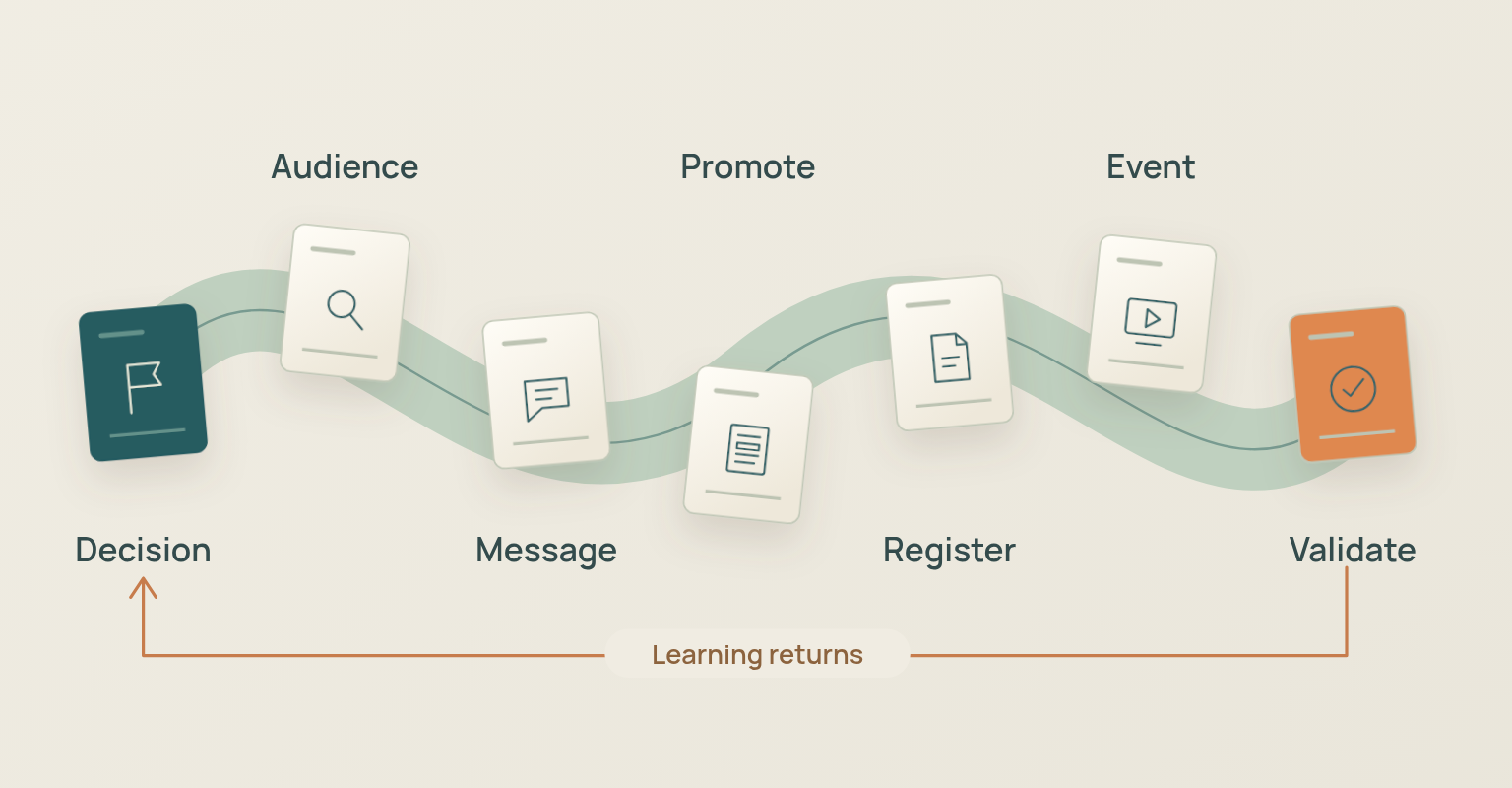
Research reduces uncertainty; it cannot predict every result. Validate the model with controlled tests that carry a specific hypothesis: one topic against a defined segment, one partner route, one audience source, one change in problem language. Keep source naming intact so registrations, attendance, questions and later actions can be compared without mixing routes.
A failed test does not prove the audience is wrong. The message, offer, timing, speaker, page, format or execution may be the problem. Review the complete path and record which assumption was tested, so a segment is not discarded because one weak creative asset failed.
Report Findings with Their Population and Limits
Every conclusion should carry enough context to be interpreted: who was included, how they were recruited, when the data was collected, what was asked, which sources were used and where the sample is weak. "B2B buyers prefer" is not a sentence to write when the evidence comes from five customers in one market or from one platform's visible users.
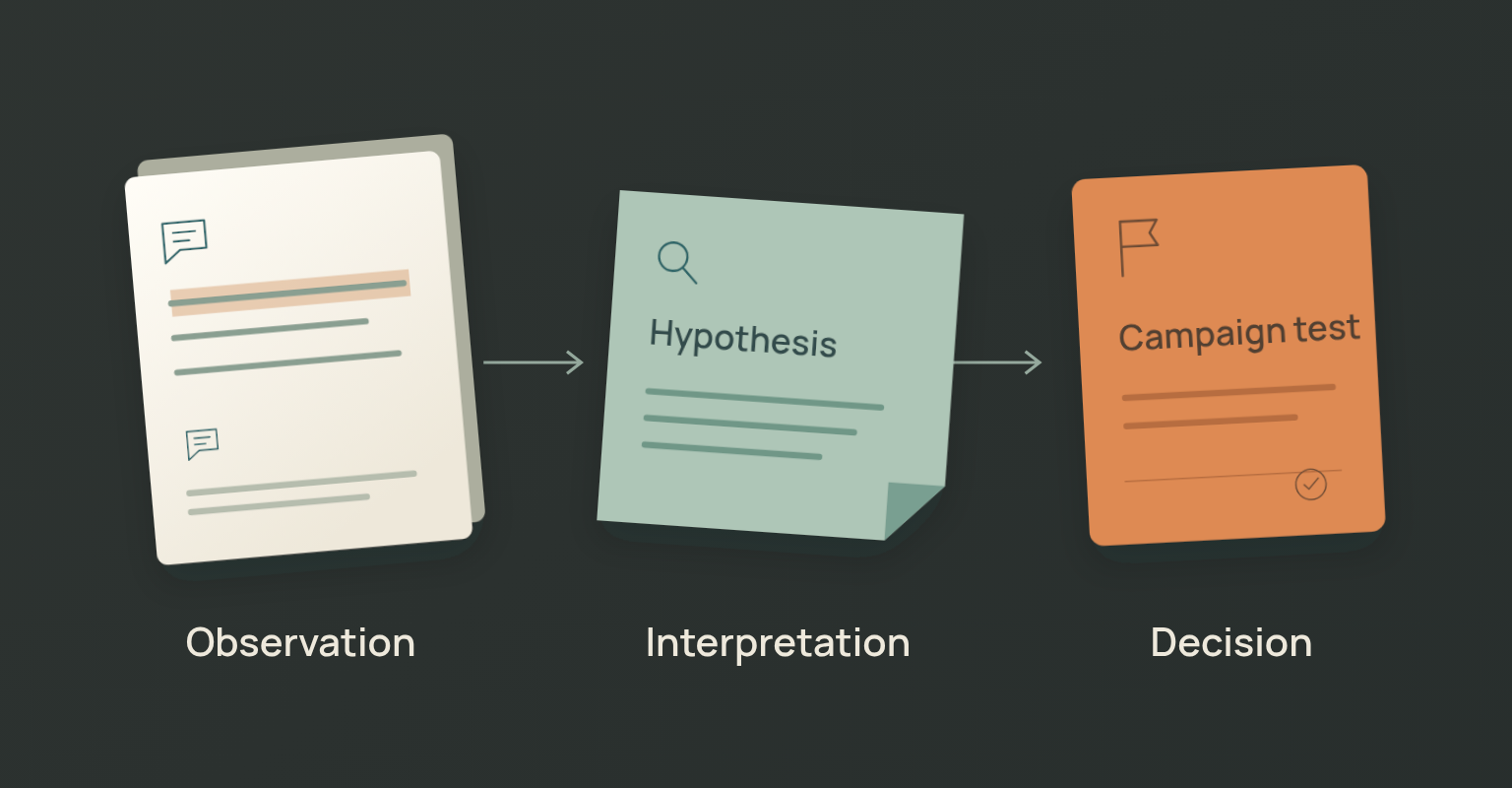
A simple claim structure helps: Observation, Interpretation, Decision. The observation states what the research recorded, the interpretation what the team thinks it means, the decision what will be tested or changed. Keeping the layers separate stops one quote or one data point from becoming a market fact.
| Layer | Example | Standard |
|---|---|---|
| Observation | Seven of twelve interviewees named peer communities before vendor webinars when describing early research. | State the sample and behavior that was actually observed. |
| Interpretation | Peer validation may matter earlier than vendor education for this segment. | Use conditional language and preserve alternative explanations. |
| Decision | Test a partner or practitioner led invitation route before increasing owned list frequency. | Turn the interpretation into a measurable action. |
Use JakoMeet after the Audience Model Is Clear
JakoMeet does not replace audience research; it becomes useful once the team can define the event audience, the registration promise, the reach plan and the measurement model. When owned reach is limited, Audience Boost extends reach with aggregate targeting criteria; configure it from researched criteria rather than using it to decide who the audience is. Non-registrants stay hidden, and people who register enter the normal event journey.
Afterwards, registrations, attendance, questions, poll results and source data are campaign evidence that can confirm or challenge the working model, without making every attendee a qualified buyer. For demand programmes, see lead generation webinars; for the sequence from event creation to follow-up, how a webinar runs in JakoMeet.
Common B2B Audience Research Mistakes
- Starting with a persona template. The template invites invented demographics, preferences and objections before evidence exists. Start with a decision and a population.
- Treating the CRM as the market. CRM records describe the people and accounts that reached your current commercial system, not the ones your channels never touched.
- Asking customers to predict future behaviour. People explain a recent decision well and predict attendance, clicks or purchases poorly. Validate stated intent with behaviour and tests.
- Confusing a large social audience with reach. Visible members prove relevant people exist in a channel, not that the team can reach them, fit the context or make the economics work.
- Averaging different roles into one buyer. A user, a manager, a finance reviewer and a security reviewer want different evidence; a blended message satisfies none of them.
- Publishing research without method context. A percentage without population, sampling, wording and timing sounds more general than the evidence allows.
- Using research participation as a sales trigger. Trust ends when an interview turns out to be prospecting. Keep research and commercial follow-up distinct and explicit.
Frequently asked questions
What Is B2B Audience Research?
B2B audience research is the systematic process of defining which companies and people matter for a marketing decision, gathering evidence about their problems, roles, language, information sources, and channel behavior, and validating those assumptions before scaling a campaign.
How Is Audience Research Different from an ICP?
An ideal customer profile describes the type of account a company wants to serve. Audience research tests and expands that definition with evidence about real people, buying roles, problem language, information habits, access paths, and differences between segments. An ICP can guide research, but it should not be treated as proof.
How Do You Research a B2B Target Audience?
Start with the business decision, define the account boundary, map the relevant roles, review first party evidence, interview people from the target population, study the sources and channels they use, document conflicting evidence, and validate the working model with small campaign tests.
Which Data Sources Are Most Useful for B2B Audience Research?
Useful sources include CRM and customer records, sales and support conversations, previous event and campaign data, customer interviews, prospect interviews, search language, industry classifications, relevant publications and communities, and carefully sourced quantitative research. No single source should be treated as the whole audience.
How Many Customer Interviews Do You Need?
There is no universal interview count for every B2B audience study. The number depends on the research question, how narrow the population is, how many distinct roles or segments matter, and how much new information continues to appear. Use interview counts as planning inputs, not as a guarantee of representativeness.
How Do You Find Where B2B Buyers Pay Attention?
Ask buyers where they learn, search, compare, and seek advice, then verify those answers with observable evidence such as search results, publication audiences, community activity, referral sources, partner data, and campaign tests. Presence in a channel does not automatically mean the channel is reachable or efficient for your team.
Can Social Media Data Represent the Whole B2B Audience?
No. Social media can reveal language, topics, creators, communities, and visible behavior, but it only reflects the people and actions visible on that platform. Treat it as one evidence source and compare it with interviews, first party data, search behavior, customer records, and other research.
How Often Should B2B Audience Research Be Updated?
Update the working audience model when the market, product, buying process, channels, or campaign performance changes materially. Review evidence after major campaigns and events, and refresh assumptions that no longer match observed source quality, questions, objections, or buying roles.
Sources and Further Reading
- U.S. Census Bureau: North American Industry Classification System: Standard classification used by U.S. federal statistical agencies for business establishments. Used here as a market boundary input, not as a complete ICP (opens in a new tab)
- McKinsey: Five Fundamental Truths: How B2B Winners Keep Growing: 2024 B2B Pulse Survey of nearly 4,000 decision makers across 13 countries. Used for directional context on multichannel B2B interaction behavior (opens in a new tab)
- Ipsos: The Right Blend: 2024 vendor guidance on B2B quantitative sample quality, respondent verification, and variation among sample sources. Used as directional sample quality context (opens in a new tab)
- Pew Research Center: Writing Survey Questions: Method guidance on question wording, question order, response options, pilot testing, and avoiding ambiguous or double barreled questions (opens in a new tab)
- Hennink and Kaiser: Sample Sizes for Saturation in Qualitative Research: 2022 systematic review indexed by PubMed. Used to explain why qualitative interview counts depend on population and research design rather than a universal quota (opens in a new tab)
- ICC/ESOMAR International Code on Market, Opinion and Social Research and Data Analytics: 2025 professional code covering research transparency, data minimisation, primary data collection, fit for purpose, limitations, and separation of research from non research activity (opens in a new tab)