
DEMAND GENERATION
Lead Qualification Framework: From Engagement Signals to Sales Handoff
Build a lead qualification process that connects webinar engagement with account context, follow-up evidence, and clear sales handoff criteria, without treating every registrant as a ready buyer.
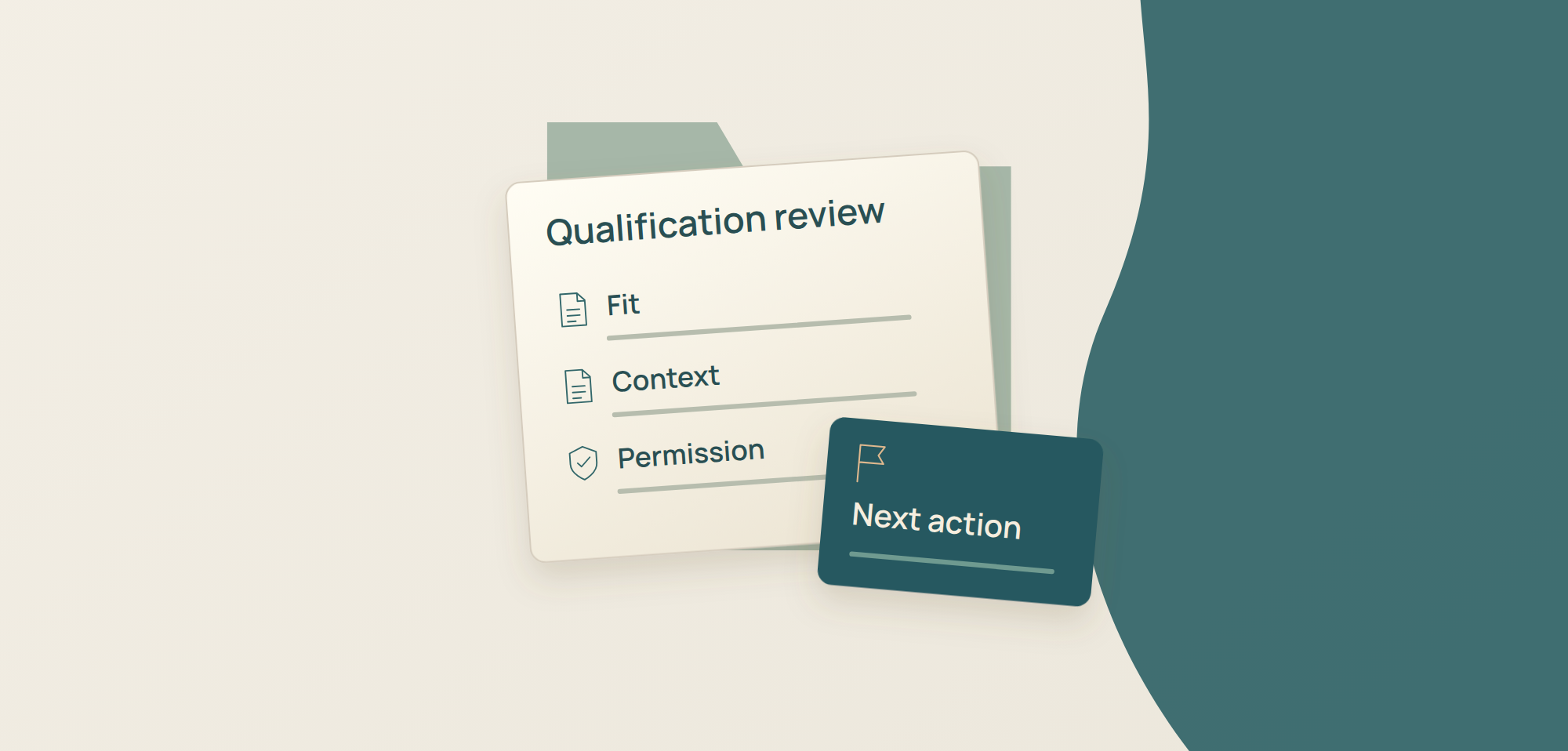
In webinar and event programmes, qualification evidence includes registration source, attendance, interaction, account context and follow-up behaviour. Registration shows interest in a topic; it does not establish fit, purchase authority or readiness for a sales conversation.
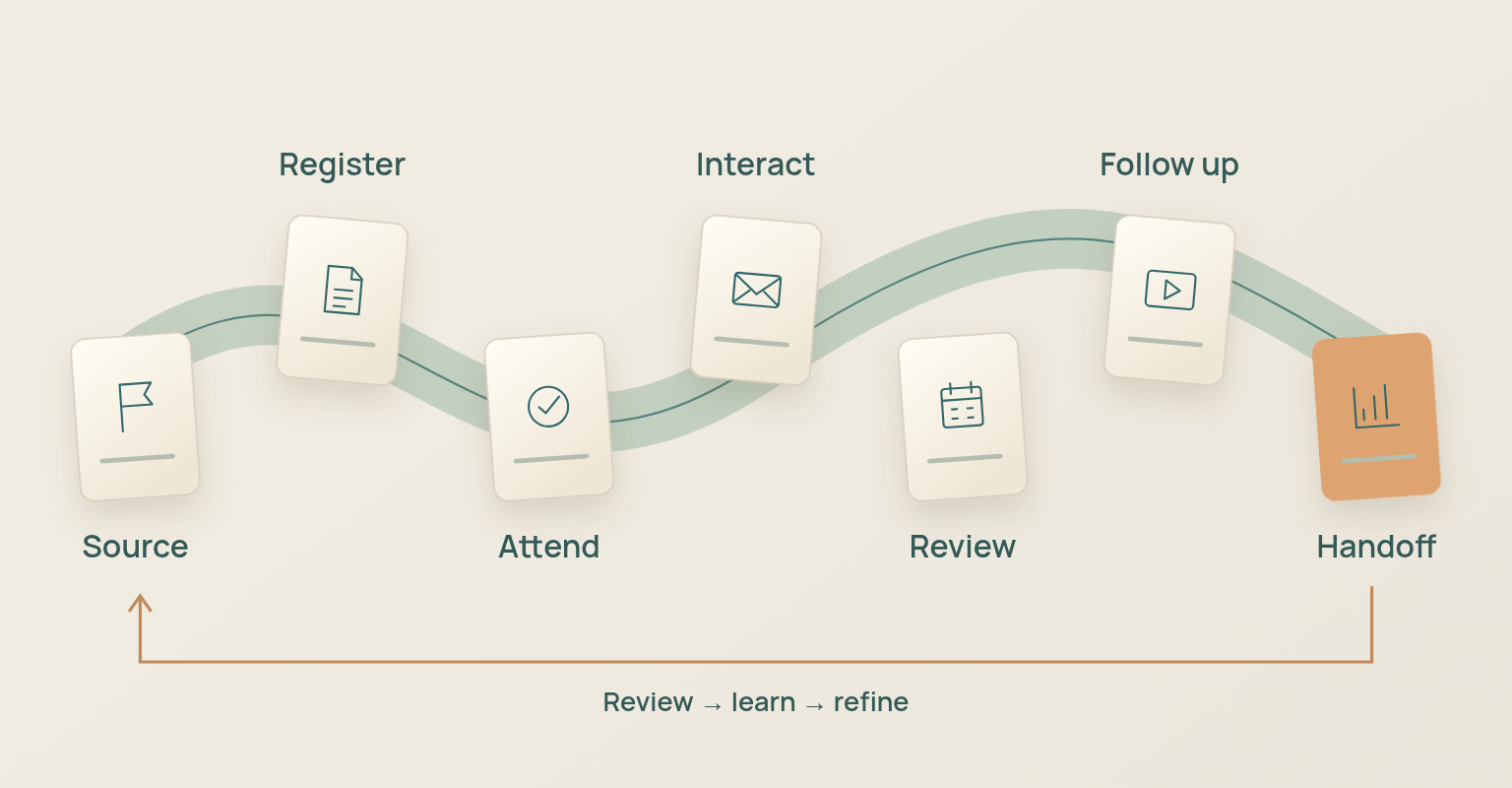
A useful qualification workflow keeps the evidence sequence intact: source, registration, attendance, interaction, follow-up and handoff. Each stage answers a different question. Where did the contact come from? Did they attend? What did they ask or choose? What happened after the session? Which contacts, accounts or buying groups have enough evidence for a marketing, customer or sales action? Sales should never be asked to interpret a spreadsheet of registrants without that context.
Lead Qualification Framework at a Glance
| Stage | Audience State | Primary Job | Evidence Created | Next Decision |
|---|---|---|---|---|
| Reach | Relevant people who may not know the event | Earn attention from the right audience | Channel, source, partner, audience criteria | Continue, change the message, or change the source |
| Register | Known registrants | Capture access details and useful context | Contact, company or role fields, source, consent, registration time | Confirm access and move out of acquisition messages |
| Attend | Attendees and no-shows | Separate live participation from registration | Attendance status, time joined, replay availability where supported | Choose attendee and no-show follow-up paths |
| Engage | Attendees who interact or observe | Capture questions, poll responses, and topic interest | Question text, poll response, session context | Answer, nurture, review, or route |
| Follow Up | Attendees, no-shows, questioners, customers | Deliver value and assign the right next action | Replay or resource clicks, replies, meetings, sales acceptance | Continue marketing, send to sales, or close the loop |
| Measure | Campaign, contact, account, and buying group | Evaluate source quality and business progression | Conversion, attendance, handoff, opportunity, and pipeline data | Improve the next campaign and reporting model |
The stages connect, but they should not be collapsed into one score. A registration source tells you how the audience arrived. Attendance tells you whether the person joined. A question provides context about a concern or decision. Sales acceptance tells you whether the handoff met an agreed standard. Revenue requires a separate opportunity and attribution system.
Define the Campaign Objective Before Collecting Leads
A lead-generation webinar begins with one business objective and one attendee outcome. "Generate leads" is not specific enough to guide the topic, audience, registration form, promotion, live interaction or follow-up. Decide whether the campaign should create new demand, engage named accounts, support an existing opportunity, educate an early-stage market, introduce a product category or identify people with a particular operational problem.
The attendee outcome must stand on its own: a person should be able to explain what the session will help them understand, compare, decide or do without reference to your internal funnel stage. The campaign objective belongs to the organiser; the learning outcome belongs to the attendee. The webinar planning checklist covers audience, outcome, format, ownership, follow-up and measurement before lead capture begins.
Choose One Primary Demand Objective
| Objective | Audience Design | Primary Evidence | Typical Next Action |
|---|---|---|---|
| New audience creation | A defined market problem beyond the owned database | Source, fit, registration, attendance, content response | Nurture, audience learning, selective sales review |
| Named-account engagement | People from target accounts or buying groups | Account coverage, attendance, questions, multiple contacts | Account review and coordinated follow-up |
| Opportunity acceleration | Known contacts in an active evaluation | Attendance, decision questions, stakeholder participation | Seller follow-up and buyer-enablement resources |
| Product or category education | People learning a new workflow or capability | Topic questions, poll responses, replay behavior | Education sequence, demo, or relevant resource |
| Customer expansion or adoption | Existing customers with a defined use case | Account, product context, questions, participation | Customer success or account-team action |
A webinar can support pipeline, but the webinar itself does not prove pipeline. Define which outcomes belong to the webinar report and which require CRM, opportunity, sales activity or customer data.
Build for a Buying Group, Not an Isolated Form Fill
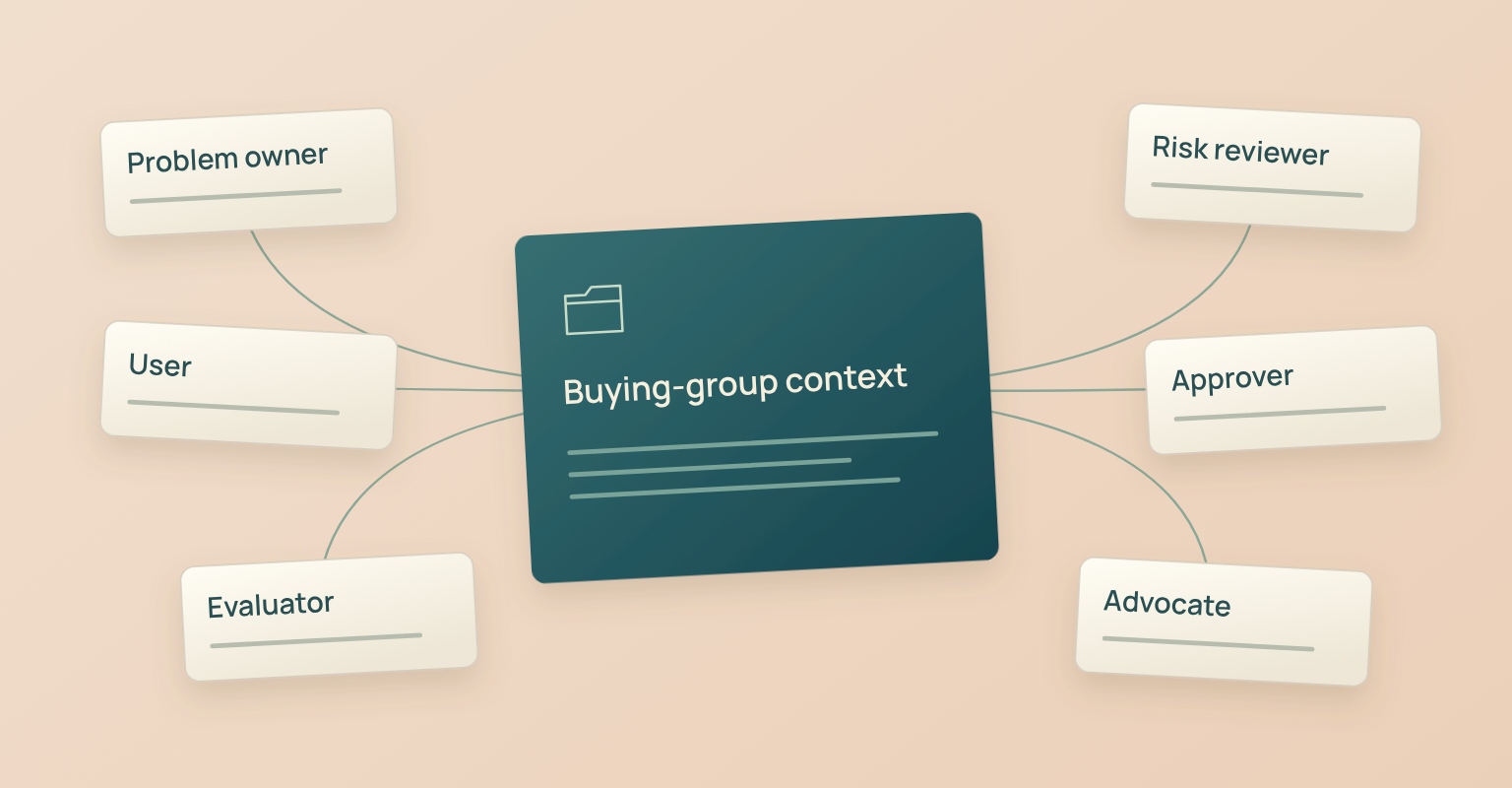
B2B buying rarely depends on one contact. 6sense's 2025 B2B Buyer Experience Report, based on nearly 4,000 buyers, reports that buying groups commonly involve more than ten people for substantial purchases, that 95% of winning vendors were already on the Day One shortlist, and that 79% of first seller engagements were initiated by buyers. A registrant therefore arrives with prior knowledge, existing preferences and colleagues who may not attend the same session.
Design the webinar so one participant can carry useful evidence back to the group: clear frameworks, decision criteria, examples, answers, replay access and resources that survive outside the live room. Do not assume the attendee has final authority, or that one enthusiastic question represents account consensus.
Forrester's buying-group guidance recommends defining target accounts and potential opportunities, detecting active buying groups and using intent signals to advance opportunities. Applied to webinars: look for multiple contacts, related questions, known account activity and existing opportunity context, and keep every observation traceable to its source.
Map Contact Evidence to Account Context
| Observation | Contact-Level Meaning | Possible Account-Level Meaning | Do Not Assume |
|---|---|---|---|
| One person registers | The person sees enough relevance to exchange information | The topic may be relevant to the account | The account is in market |
| One person attends | The person allocated time to the session | The account has at least one engaged member | The attendee owns the decision |
| Several people from one company attend | The webinar reached multiple colleagues | A buying group or internal learning need may exist | All contacts are evaluating the same opportunity |
| A buying question is asked | A specific decision or concern exists for the person | The question may reveal an account requirement | The person is ready for sales |
| Replay or resource is shared | The content continues after the event | Other stakeholders may be involved | A deal has advanced |
Reach a Defined Audience and Preserve the Source
Lead quality starts before registration. If the campaign reaches a broad, weakly related audience, the form and follow-up cannot create relevance later. Define who should care, why the problem matters now, which channels can reach that audience and what each source is expected to contribute. The four-week promotion plan coordinates owned email, company channels, speakers, partners, communities, paid reach and source naming; assign consistent campaign, source, medium and content values before the first link is distributed.
Use Owned, Borrowed, and Managed Reach for Different Jobs
| Reach Type | Best Used For | Main Risk | Evidence to Preserve |
|---|---|---|---|
| Owned contacts | Known audiences with a relevant relationship or permission context | Over-mailing or treating the full database as relevant | List or segment, send status, source, registration |
| Speakers and partners | Borrowed trust, subject expertise, and adjacent audiences | Large but poorly matched reach, inconsistent messages | Contributor, route, link, audience context |
| Organic social and communities | Public discovery and peer conversation | Posting links without contributing value | Platform, post or placement, message angle |
| Paid media | Extending a proven message to a defined audience | Buying traffic before the page and promise work | Audience, creative, spend, source, conversion |
| Managed audience reach | Reaching relevant people beyond the owned list under defined eligibility | Confusing invitation delivery with contact ownership | Target criteria, eligibility, registrations, source |
Eligible organisers can reach relevant professionals beyond their owned list with Audience Boost. JakoMeet sends the invitations, non-registrant identities stay hidden, and people enter the normal event flow only after registering. Treat it as a reach and registration source, not as a purchased contact list.
Reach and Source Check
- The target audience is defined by role, context, problem and reason to care now.
- Every distribution route has an owner, message angle and tracked source.
- Owned contacts have a relevant permission or relationship basis for the message.
- Speaker and partner links are distinguishable from company links.
- Paid or managed reach has a defined audience, budget, eligibility rule and stop condition.
Design Registration for Access and Useful Context
The registration page should help the right person make a clear decision and collect only the information the campaign can use. A form that asks for extensive qualification data before the visitor understands the value transfers internal uncertainty to the registrant. Decide which information is required to deliver the event and which genuinely changes segmentation, routing, reporting or follow-up. A field should have an owner and a defined use before it appears on the form; the landing page guide covers the promise, structure, fields, consent, confirmation and source tracking.
Separate Registration Data from Qualification Evidence
| Data Type | Examples | What It Can Support | What It Cannot Prove |
|---|---|---|---|
| Access identity | Name, email, country, time context | Registration, confirmation, access, support | Buying authority or readiness |
| Firmographic context | Company, role, industry, seniority | Segmentation, routing, account matching | Active demand by itself |
| Source context | Owned email, speaker, partner, paid, Audience Boost | Channel and audience analysis | Revenue attribution by itself |
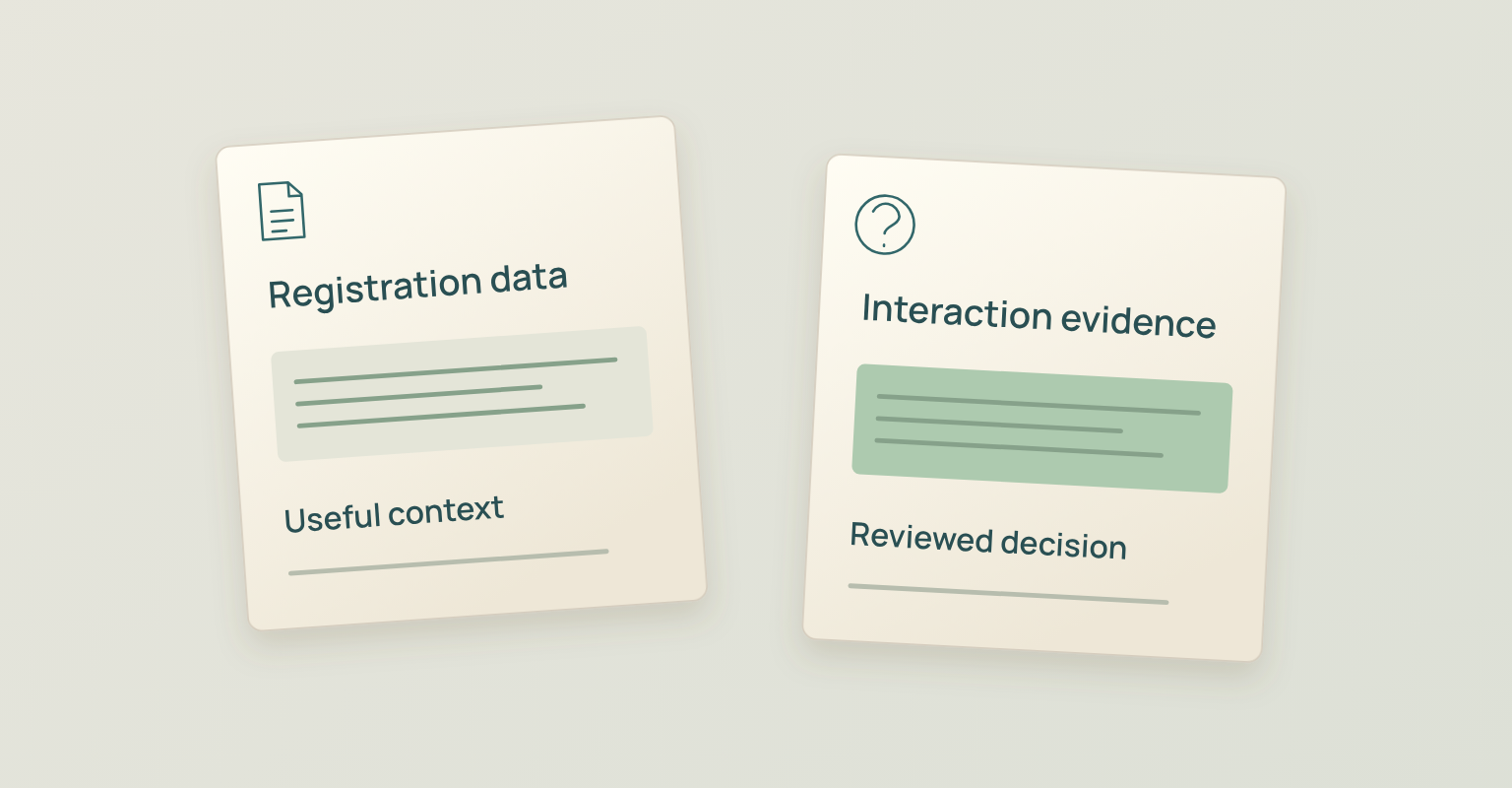
| Declared context | Optional question about challenge, priority, or use case | Content adaptation and follow-up relevance | Truth, urgency, or budget without validation |
| Permission and preference | Consent, opt-in, unsubscribe, communication choice | Communication governance and suppression | Unlimited permission for unrelated outreach |
For UK audiences, ICO guidance on business-to-business marketing explains that electronic direct-marketing rules depend on the communication method and type of business contact, and that identifiable business contacts retain data-protection rights. Other jurisdictions differ. Review registration, event delivery, marketing permission and sales follow-up for the audience and market rather than treating them as one automatic permission.
A registrant has expressed enough interest to register for the webinar. Qualification requires additional evidence about fit, context, behaviour, buying group and an agreed next action.
Move Registrants from Acquisition to Attendance
Once a person registers, the campaign job changes. Stop sending acquisition messages to that contact where the system supports it. Confirm success, repeat the exact date and time zone, explain the access path, offer a calendar action and send reminders that reduce joining friction. The webinar email templates separate nonregistrants, registrants, attendees and no-shows, so the same person never receives an invitation and a confirmation at the same time.
Attendance is a stronger behavioural signal than registration because the person allocated time to the live session. It still requires context. A customer attending training, a partner supporting a speaker and a new prospect evaluating a category should not enter the same sales queue.
Attendance Readiness Check
- Registration confirmation states the date, time zone, duration, access model and support route.
- Registrants exit invitation flows where possible.
- Reminders add access value rather than repeating promotional copy.
- The live access action is clear on mobile.
- Attendee and no-show status can be verified before follow-up begins.
Use the Live Session to Create Useful Context
A lead-generation webinar should teach first and create interpretable evidence second. The event does not need constant interaction; it needs purposeful moments where the audience can reveal which decisions, obstacles or examples matter. Clear production roles and a run of show let the host guide the audience, the producer operate the room and the moderator manage questions without forcing the presenter to do everything at once.
Choose Interaction That Changes the Conversation
| Interaction | Useful When | Evidence Created | Interpretation Limit |
|---|---|---|---|
| Moderated Q&A | The topic produces decision, implementation, or comparison questions | Question text, topic, timing, contact identity where available | A question may be curiosity, research, customer support, or buying work |
| Poll | The answer changes what the speaker explains or how follow-up is segmented | Selected option and session context | The option set constrains the answer and may not reflect urgency |
| Chat | Visible peer discussion adds value and staffing supports moderation | Comments, recurring themes, support needs | Activity volume can reflect sociability more than purchase intent |
| Live demonstration | The audience needs to see a workflow, result, or constraint | Questions, reactions, requested detail | Interest in the demonstration is not a commitment to buy |
| Resource or CTA | The audience needs a practical next step | Click, request, reply, meeting, download | A click does not prove opportunity progression |
Do not manufacture engagement to create a score. A decorative poll increases activity without increasing understanding. A specific question about implementation, security, integration, timing or internal approval is worth more than ten generic reactions.
Separate Facts, Signals, Interpretations, and Decisions
The fastest way to damage a qualification framework is to turn every behaviour into purchase intent. Build an evidence hierarchy so marketing and sales can see what was observed, what it may mean and who is allowed to decide the next action.
| Layer | Example | Owner | Rule |
|---|---|---|---|
| Fact | Registered from partner email; attended live; asked one question | System and campaign owner | Record exactly what happened without adding intent language |
| Signal | Question concerned implementation effort and internal stakeholders | Marketing or subject-matter reviewer | Classify the topic and context; preserve the original wording |
| Interpretation | The account may be evaluating implementation feasibility | Marketing and sales review | State uncertainty and check account or opportunity context |
| Decision | Send a relevant implementation resource and assign seller review | Named owner under agreed SLA | Choose one next action, due date, and evidence requirement |
Gartner's 2026 survey of 645 B2B buyers found that buyers used an average of seven information sources, 45% used generative AI, and 69% preferred to validate AI-generated insights with a sales representative. At the same time, 67% preferred a representative-free experience and 70% preferred fully digital self-service. The implication for webinar follow-up is to provide self-service value and introduce a person when validation, context, risk reduction or a specific decision justifies it, rather than sending everyone to sales.

Segment Follow-Up by Behavior, Fit, and Relationship
Prepare the follow-up framework before the event, then fill it with the verified outcome. The useful segment is rarely "all registrants". It is the intersection of audience fit, relationship, attendance, interaction, account context and permission.
| Segment | Evidence | Primary Follow-Up | Sales Review |
|---|---|---|---|
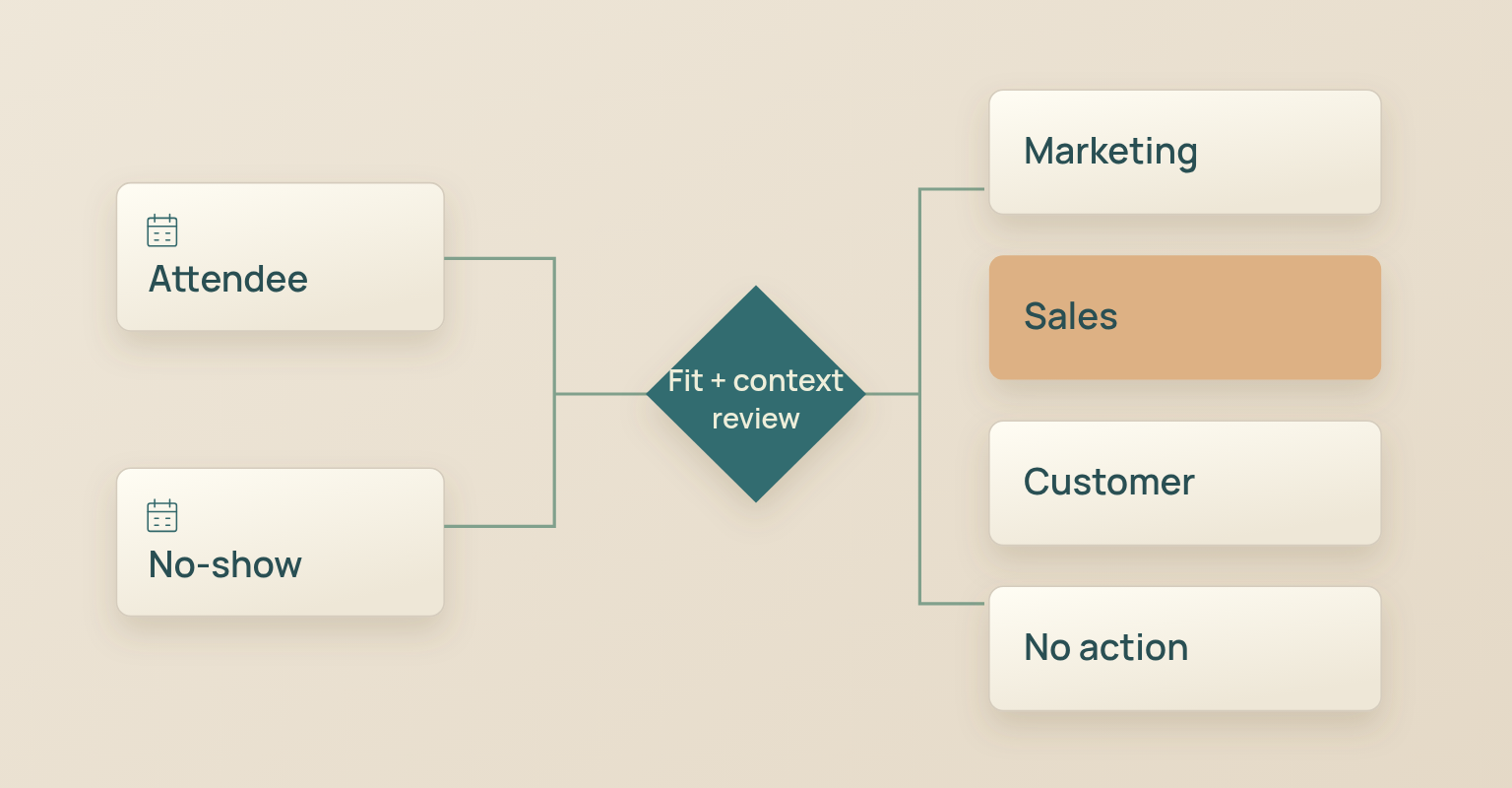
| Relevant attendee, no direct question | Fit plus live attendance | Recap, replay, resources, and low-friction next action | Only if account or existing opportunity context warrants it |
| Attendee with an operational question | Attendance plus a specific workflow or implementation question | Answer the question and share the relevant resource | Review when the question connects to a qualified account or active need |
| Attendee with a buying-context question | Attendance plus a question about evaluation, security, pricing, rollout, or stakeholders | Accurate answer, specialist resource, and clear contact route | Priority review under the agreed handoff rule |
| No-show who uses the replay | Registration plus verified replay or resource action | Replay path, section guidance, and relevant next step | Review only with fit and account context |
| No-show with no later action | Registration only | One useful follow-up, then appropriate nurture or suppression | Do not send by default |
| Existing customer | Known customer relationship plus event behavior | Customer-success or account-team path | Route to the relationship owner |
| Multiple contacts from one account | Several verified contacts and related activity | Coordinate content and ownership at account level | Review as a possible buying group, not separate disconnected leads |
TrustRadius's 2025 buyer research reports that 77% of surveyed technology buyers checked user reviews and 54% spoke with a current user before purchase. For webinar follow-up, that means giving buyers credible evidence they can verify and share: a customer example, a peer perspective, implementation detail or a transparent limitation often helps more than an immediate generic sales request.
Create a Sales Handoff That Preserves the Evidence
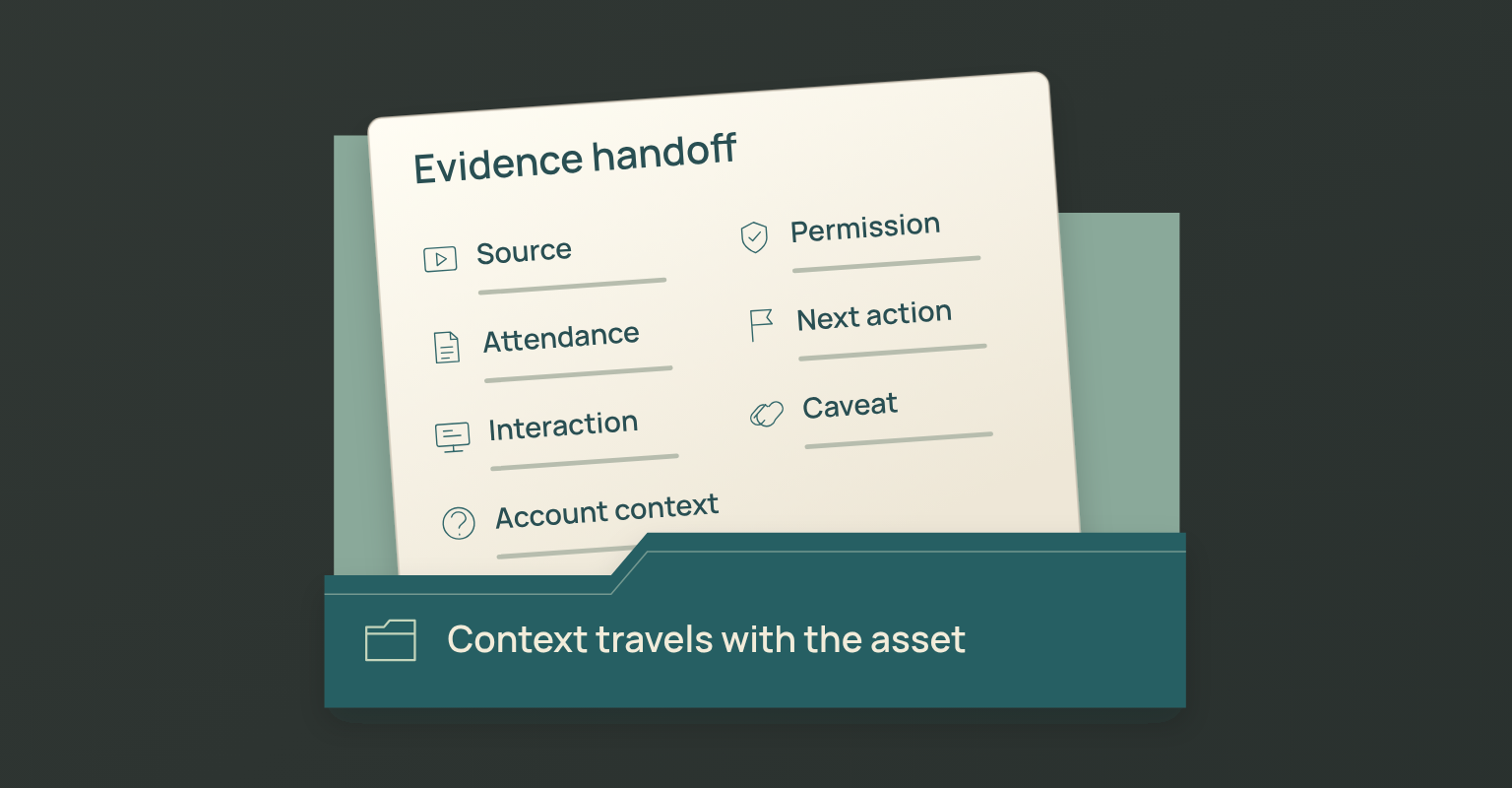
A sales handoff should reduce research work for the seller without inventing certainty. It tells the seller why the contact is being reviewed, what happened, what the person asked, which account or opportunity may be involved and what action is recommended.
Minimum Webinar Handoff Packet
| Field | What to Include | Why It Matters |
|---|---|---|
| Contact and account | Name, role, company, account match, known relationship | Prevents duplicate research and incorrect routing |
| Campaign context | Webinar title, objective, date, audience, organizer | Explains what the person expected from the event |
| Source | Owned segment, partner, speaker, paid, managed audience, or other route | Preserves the acquisition context |
| Attendance | Attended, no-show, replay activity where available | Separates registration from actual content consumption |
| Interaction | Original question, poll response, resource request, relevant reply | Lets the seller see the evidence rather than a label |
| Buying-group context | Other verified contacts, roles, related activity, opportunity linkage | Supports account-level review without merging unrelated behavior |
| Permission and preferences | Allowed communication route, objections, suppression, owner | Protects the contact experience and legal process |
| Recommended action | Resource, answer, seller review, customer action, nurture, or no action | Creates a clear next step instead of an unowned record |
| Caveat | What the webinar data does not prove | Prevents activity from becoming false intent |
Salesforce's 2026 State of Sales research, based on more than 4,000 sales professionals, reports that disconnected systems slow AI initiatives for many sales leaders and that teams using AI are prioritising data hygiene. The lesson is basic: clean identifiers, stable source names, deduplication, field ownership and traceable evidence matter before scoring or automation can help.
Do not pass a person to sales because a platform can produce a score. Pass a person or buying group when the evidence, account context, ownership, permission and recommended action meet an agreed rule.
Use Decision Rules before Lead Scores
A score can summarise evidence, but it can also hide why the score exists. Start with transparent decision rules and introduce scoring only when the team can audit the inputs, weighting, decay and outcomes.
| Decision Path | Minimum Evidence | Owner | Next Action |
|---|---|---|---|
| Operational follow-up | Access issue, unanswered question, promised resource, or event-delivery need | Campaign, support, or subject expert | Resolve the issue or provide the promised item |
| Marketing nurture | Relevant fit and topic interest without a justified sales action | Demand generation or lifecycle marketing | Send the next useful content or invite |
| Sales review | Fit plus a buying-context signal, account activity, or existing opportunity | Sales or revenue owner | Review evidence and accept, reject, or request context |
| Customer follow-up | Known customer plus adoption, training, expansion, or support context | Customer success or account owner | Continue through the established customer relationship |
| No action or suppression | No fit, objection, invalid data, irrelevant source, or communication restriction | Marketing operations | Suppress, correct, or close the record |
Measure the Campaign from Reach to Revenue without Skipping Steps
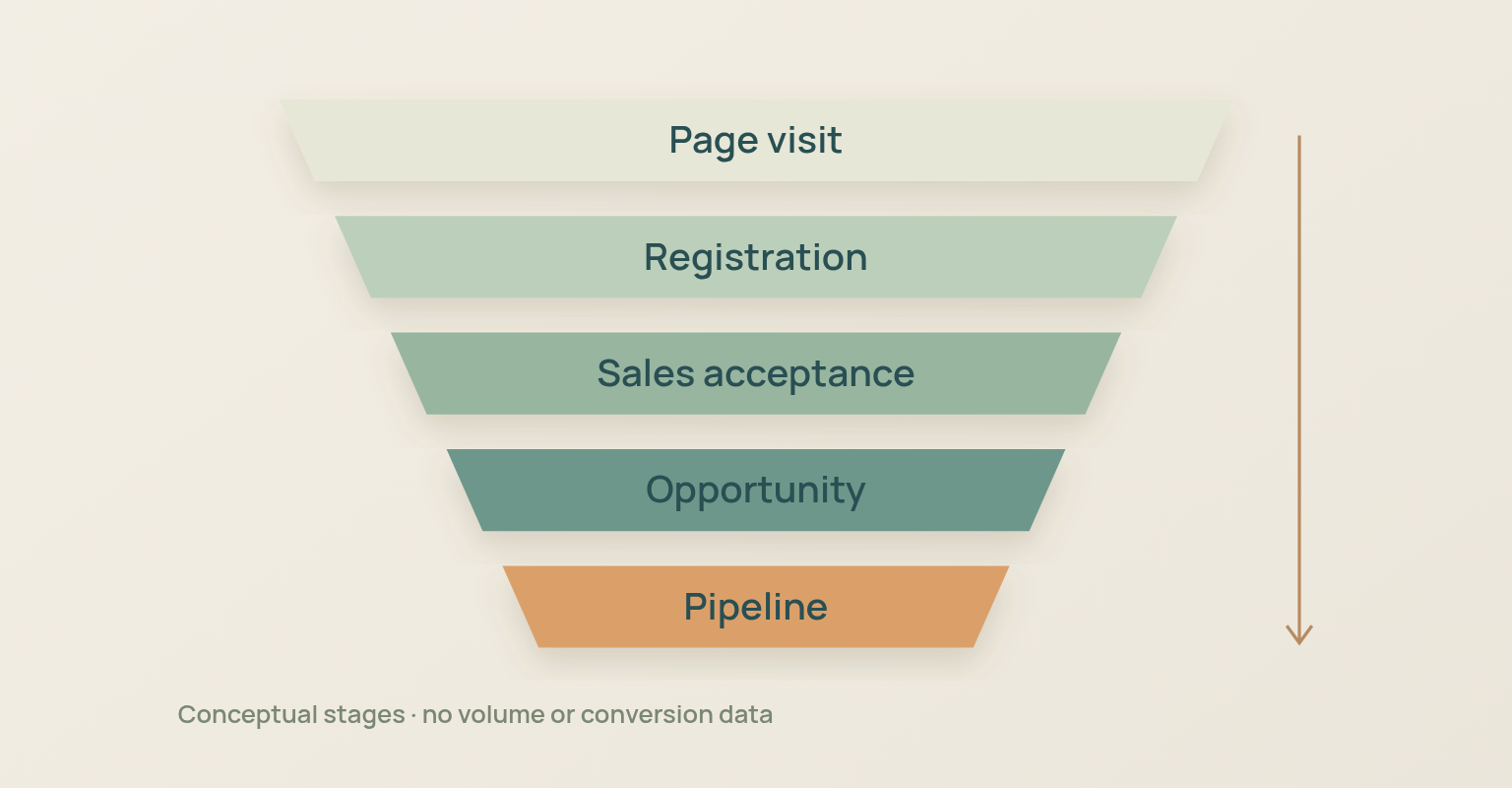
A webinar report first answers what happened inside the campaign. Revenue reporting then connects those facts to the systems that track accepted handoffs, opportunities, pipeline and closed business. Keep the definitions stable so events can be compared without changing the denominator.
| Measure | Formula or Definition | Question Answered | System of Record |
|---|---|---|---|
| Registration conversion | Completed registrations divided by defined page visits, multiplied by 100 | Did the page and audience source create registrations? | Web analytics and registration system |
| Registrations by source | Completed registrations grouped by stable source values | Which routes built the audience? | Registration and campaign tracking |
| Attendance rate | Live attendees divided by registrants, multiplied by 100 | Which sources and segments showed up live? | Webinar platform |
| Useful interaction rate | Attendees with defined useful interaction divided by attendees | How much decision-relevant context was created? | Webinar platform plus reviewed classification |
| Follow-up action rate | Contacts completing the defined next action divided by eligible recipients | Did follow-up produce the intended response? | Email, web, scheduling, or product system |
| Sales acceptance rate | Accepted handoffs divided by submitted handoffs | Did the handoff rule produce useful reviews? | CRM or revenue system |
| Opportunity and pipeline | Qualified opportunity creation and value under the company definition | Did accepted webinar activity connect to revenue work? | CRM |
| Influence | Documented relationship between the campaign and an existing opportunity under an agreed model | Did the webinar contribute to an opportunity already in motion? | CRM and attribution model |
Do not describe the webinar platform as creating revenue attribution when the opportunity and sales data live elsewhere. A clean source comparison, attendance report, question queue and follow-up record are valuable inputs, not a complete causal model. You can review registration sources, attendance and engagement data in JakoMeet; on Growth, teams can also review transcript, Q&A and poll themes as a separate interpretation layer under human control. The event metrics guide covers definitions and reporting cadence.
Common Lead Qualification and Sales Handoff Mistakes
- Calling every registrant a qualified lead. Registration shows topic interest. It does not establish fit, authority, timing, budget, urgency or buying-group consensus.
- Collecting more fields instead of creating better evidence. A long form does not replace a useful session. Ask only for information that changes access, segmentation, routing, reporting or a defined follow-up action.
- Sending the registrant list to sales without context. A spreadsheet without source, attendance, question, account, permission and recommended action forces sales to repeat the research and encourages generic outreach.
- Scoring activity without preserving the original signal. A score of 87 hides whether the person attended, asked a question, clicked a replay or belongs to an active opportunity.
- Treating one contact as the entire account. A person can be a researcher, champion, user, approver, partner, customer or competitor. Review multiple contacts and opportunity context before making account-level claims.
- Using questions as automatic purchase intent. A thoughtful question may reveal buying work, professional curiosity, support needs or research for someone else. Classify it and verify context before routing it.
- Following up with the same message for everyone. An attendee, a no-show, a customer, a direct questioner and a partner need different context.
- Claiming revenue attribution from webinar activity alone. Registration and attendance are observable facts. Revenue attribution requires opportunity data, timing, model rules and downstream evidence.
- Automating before cleaning the data model. Inconsistent account names, duplicate contacts, unstable source labels, missing ownership and unclear permission make automation faster but not more reliable.
How JakoMeet Supports Lead Qualification and Follow-Up
JakoMeet keeps the registration page, eligible Audience Boost reach, live webinar, questions, poll responses, follow-up, replay, source reporting and post-event analysis connected to the same event. Organisers can follow a contact from reach through registration, attendance, interaction and follow-up without rebuilding the campaign in separate tools, which makes it easier to preserve context before deciding whether a contact stays in marketing nurture, receives a direct response or is handed to sales. For demand programmes, see lead generation webinars.
JakoMeet does not turn every attendee into an automatic lead score or claim revenue attribution from webinar activity alone. Use the event report and AI-assisted interpretation as inputs to human review, then connect qualified follow-up to the CRM, account, opportunity or customer system that owns the outcome. For the wider lifecycle, see the full webinar workflow in JakoMeet, or compare JakoMeet plans and campaign limits.
Frequently asked questions
What Is a Lead Qualification Framework?
A lead qualification framework is a repeatable set of evidence, criteria, decision rules and ownership steps used to decide whether a contact should remain in nurture, receive direct follow-up, move to sales review or take another defined path. For webinar leads, registration, attendance, questions, poll responses, replay behaviour, account context and existing relationship inform the decision; registration alone does not qualify a person for sales follow-up.
What Makes a Webinar Lead Qualified?
Registration alone does not qualify a lead. Qualification depends on the campaign objective, audience fit, account context, attendance, questions, poll responses, replay behavior, existing relationship, and whether a relevant next step is justified. The team should define these rules before the webinar.
Should Every Webinar Registrant Go to Sales?
No. Many registrants are researching, learning, supporting a colleague, or joining from outside the target market. Sales follow-up should be reserved for contacts or buying groups whose fit, behavior, questions, and account context meet an agreed handoff rule.
Which Webinar Engagement Signals Matter Most?
The most useful signals are the ones connected to a real decision. Attendance, a specific question, a diagnostic poll response, replay activity, resource requests, and multiple contacts from the same account can add context. None of these proves purchase intent on its own.
How Should Attendees and No-Shows Be Followed Up?
Attendees should receive a recap, promised resources, answers to unresolved questions, and the next relevant action. No-shows should receive a concise route into the replay or resources without language that assumes they attended. Sales outreach should depend on fit and evidence, not attendance status alone.
How Do You Measure Lead Qualification and Sales Handoff?
Measure qualification and handoff by tracking registration source, attendance, useful interactions, contacts or accounts reviewed against the agreed criteria, follow-up actions, sales-accepted handoffs, and downstream opportunities in the systems that own those outcomes. Keep webinar reporting and revenue attribution separate unless the underlying data supports the connection.
Can Webinars Support Account-Based Marketing?
Yes. Webinars can support account-based programs when the topic, audience, speakers, promotion, registration fields, and follow-up are designed for named accounts or buying groups. Review contact activity at both the individual and account level rather than treating one attendee as the whole opportunity.
How Soon Should Sales Follow Up after a Webinar?
Sales should follow up after the team has verified attendance, questions, poll responses, account context, permissions, and ownership. A timely response to a direct buying question may happen quickly. A general attendee with no clear sales context may be better served by marketing nurture or a useful resource.
Sources and Further Reading
- 6sense: The B2B Buyer Experience Report for 2025: Buying-group size, buyer-led engagement, Day One shortlists, point of first contact, and vendor-selection behavior (opens in a new tab)
- Gartner: 69% of B2B Buyers Turn to Sales Reps to Validate AI-Generated Insights: Buyer information sources, generative AI use, self-service preference, and the role of seller validation (opens in a new tab)
- Salesforce: State of Sales Report for 2026: Research on disconnected systems, data hygiene, AI readiness, and seller productivity (opens in a new tab)
- ICO: Business-to-Business Marketing: UK-specific guidance on electronic direct marketing, business contacts, data protection, consent, and objections (opens in a new tab)
- Forrester: Six Steps to Buying Group Success: Target accounts and opportunities, active buying groups, intent signals, and opportunity progression (opens in a new tab)
- TrustRadius: Bridging the Trust Gap Media Kit: 2025 technology-buyer research on reviews, current-user conversations, AI search, trust, and research methodology (opens in a new tab)